This post may contain affiliate links, including Amazon affiliate links. If you make a purchase through these links, I may earn a small commission at no extra cost to you. I only recommend products and resources I genuinely use and believe in. Thank you for supporting Friendship IRL!
Here’s something I want you to sit with for a second:
What if the reason friendship has felt so exhausting isn’t because you’re bad at it, but because you’ve been doing it in a way that requires you to disappear a little bit every single time?
Not dramatically. Not all at once. Just… editing yourself down. Rounding off the edges. Becoming a slightly more palatable version of you so that you can fit into the room, the group, the friendship, without making anyone uncomfortable.
That’s masking. And if you’re neurodivergent, there’s a very good chance you’ve been doing it for so long that you don’t even notice it anymore.
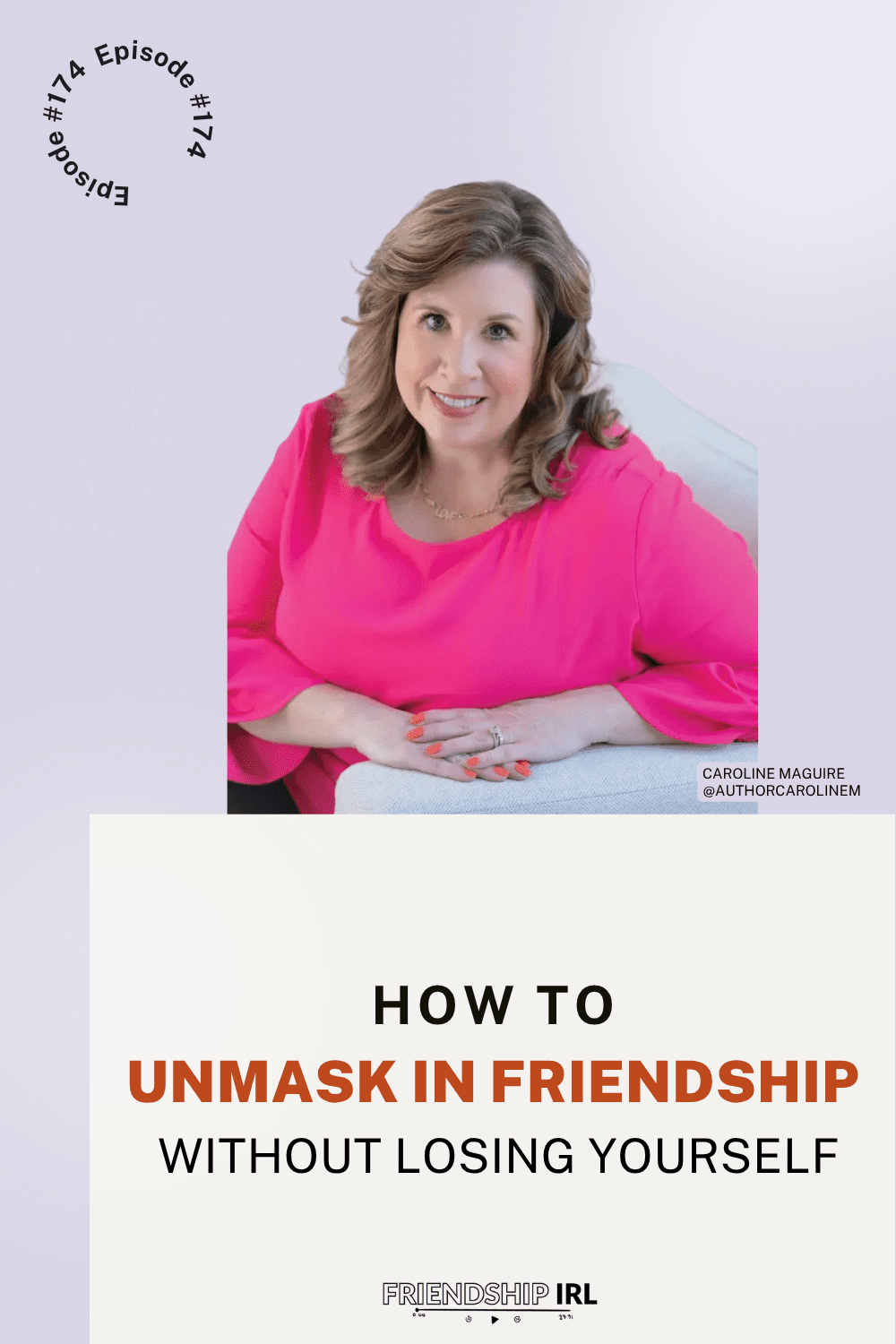
Today’s episode is with Caroline Maguire, and it’s one I’ve genuinely been looking forward to sharing. Caroline is an internationally recognized expert in social-emotional learning, ADHD coaching, and relationship development. She’s the author of the award-winning Why Will No One Play with Me? and her brand new book, Friendship Skills for Neurodivergent Adults (Balance Books, April 2026). She also hosts The ADHD Social Playbook podcast, and as someone who is neurodivergent herself, with ADHD, dyslexia, and learning disabilities, she brings both the professional expertise and the lived experience to everything she does.
We talked about:
- ▪️ Masking… and the spectrum of it
- ▪️ The difference between masking and adapting (a distinction I had never heard anyone make before, and I think it’s genuinely going to shift something for a lot of you)
- ▪️ Self-advocacy in friendship
- ▪️ Dropping pings, communication codes, and asking for what you need
- ▪️ Why friendship is a skill that ANYONE can build at any point in their life
This one is for my neurodivergent listeners, absolutely. But if you’re neurotypical? Don’t skip it. Understanding how your friends’ brains work and how to actually show up for them? That’s in here too.
Friendship Is a Skill. It Has Always Been a Skill.
One of the things Caroline and I agree on completely, and I mean completely, is that friendship is not something you either have or you don’t.
- ▪️ It’s not a personality trait you’re born with.
- ▪️ It is a skill.
- ▪️ And like any skill, it can be learned, practiced, and built at any age.
Caroline traces this belief back to a teacher she had in seventh and eighth grade who ran small therapy-style groups and met with Caroline one-on-one.
- ▪️ No shame.
- ▪️ No “you’re doing it wrong.”
- ▪️ Just: here’s what you’re good at, here’s what you could try, here’s how this works.
“She started basically talking to me about, like, it’s a skill. And she was so non-shaming, like, so wonderful. She was like, Caroline, you’re so curious, like, you can make conversation with people.”
That teacher planted something that eventually became Caroline’s entire career. And it’s the premise her new book is built on.
Here’s the thing that gets me about this: we have THOUSANDS of self-help books published every year. People are reading them to get better at things. Which means even neurotypical people are actively working to improve skills they don’t naturally have.
The idea that friendship should just magically appear, fully formed (especially for neurodivergent people who were often told “be less, be quieter, stop being so much”) is not just unhelpful.
It’s actively harmful.
You were not given a manual. You were just told to figure it out. And a lot of us didn’t.
🎧 The full episode goes deep into how both Caroline and I built this skill from scratch. Starting from some pretty lonely places. It’s worth hearing.
The Masking Spectrum (And Why It’s Not All or Nothing)
If you spend any time in neurodivergent spaces online, you’ve heard about masking. The discourse is everywhere. And a lot of it presents masking as something you either do or you don’t. Something to shed as quickly and completely as possible.
Caroline’s take is more nuanced than that. And honestly, more useful.
Masking, as she defines it, is suppressing your neurodivergent traits to the point where you lose yourself. You don’t know what you actually like anymore. You’ve been shape-shifting for so long that the shape-shifting IS the self. And it happens because people genuinely cannot survive in certain environments without it.
“People do this because they can’t survive in a certain environment, and so they have to pretend in order to survive, and they fall into it.”
But masking is a spectrum.
- ▪️ There are people who mask a little.
- ▪️ There are people who mask a lot.
And the unmasking journey?
- ▪️ It’s not overnight.
- ▪️ It’s not a switch you flip.
- ▪️ It’s layers.
(My oldest friend and I literally call it “peeling the onion.” I’ve been six years into my ADHD diagnosis and last WEEK she said to me, “another layer of the onion,” because something I’d been quietly suppressing for years finally just… came out. That’s how this works.)
What I loved in Caroline’s book, and what I pushed her to talk about in the episode, is the exercise she created for recognizing where you’ve ALREADY been unmasking, in small ways, in specific contexts. Giving yourself credit for the micro-steps instead of only measuring against some fully-unmasked ideal that doesn’t really exist.
“Unmasking is not simple. This journey is not simple. And so if you’re struggling and you need to make micro steps, like, that’s what you need to do. Don’t let anyone shame you about that.”
Masking vs. Adapting: The Distinction That Changes Everything
Okay. This is the one I want you to really hear.
There’s a difference between masking and adapting. And I had genuinely never heard anyone articulate it this clearly before I read Caroline’s book.
MASKING is powerless.
- ▪️ It’s suppressing who you are because you feel like you have no choice.
- ▪️ It increases your stress.
- ▪️ It chips away at your sense of self.
- ▪️ It’s not a decision you’re making from your authentic self.
- ▪️ It’s a survival response.
ADAPTING is a choice.
- ▪️ It’s temporary.
- ▪️ You’re still you.
- ▪️ You know you’re doing it.
- ▪️ You’re doing it from a place of genuine care or genuine desire… not fear.
Caroline’s example is perfect:
“That really close friend of mine had a 50th birthday at eight o’clock at night in January in downtown Boston. I really like to go to bed early. I’m always tired. I don’t drink, so I’m not really into certain scenes. But I adapted and I went because it was really, really important to her, and I’m glad that I did. That’s adapting. It’s temporary. I made a choice. I don’t feel powerless. I make allowances and I’m going along with people, but by choice.”
She told her friend it was late. She wasn’t hiding it. She showed up anyway because she loves her.
That’s not masking. That’s friendship.
That’s what it looks like to accommodate someone you care about from a place of authenticity instead of fear.
And this works in both directions. My neurotypical friends adapt to me, too. When I’m info-dumping and leaping between topics, they have a code word: “circles.”
Meaning: I can’t follow you; give me the connectors.
That’s them adapting to how my brain works. Not asking me to stop. Not telling me I’m too much. Just flagging that they want to stay on the ride with me, and they need a little help.
That’s what reciprocal friendship actually looks like.
“The all-or-nothing thinking of the internet is sometimes like, well, we shouldn’t have to explain ourselves. Except when sometimes I am going in circles, sometimes people can’t follow me. And I think people are willing to take that ride with you if you flag it a little bit.”
🎧 There’s a lot more in the full episode about how this masking vs. adapting distinction plays out in real friendships, including some specific examples from Caroline’s own life.
Self-Advocacy Is Not a Burden. It’s a Gift to Your Friendships.
This is the part I think many neurodivergent people need to hear most.
Asking for what you need in friendship is not high-maintenance. It is not too much. It is not something you should feel shame about.
Caroline has a friend with auditory sensory sensitivities so significant that if they go to a loud restaurant, she’ll wake up the next day with no memory of the conversation and spend days recovering from the overstimulation.
So they just… don’t go to loud restaurants. Instead, they:
- ▪️ Go for walks
- ▪️ Hang out at each other’s houses
- ▪️ Go paddleboarding
It’s not hard. It just requires knowing and saying what you need.
I have a list, an actual list, of food-safe products by brand that I share with close friends when they’re cooking for me. Specific mayos. Specific bread. Specific salad dressings.
My friends don’t find this burdensome. They find it actionable. They show up to dinner proud that they checked the list. They want to take care of me. Knowing HOW to take care of myself makes that possible.
It’s the same thing. Completely the same thing.
“If you being late really makes someone so unhappy and miserable, then maybe they’re not your people. If you needing these food things is really such a big deal to someone, then they’re not your people.”
Caroline also talks about what she calls a “communication where,” which is basically a brief explanation of how you process or what you need before you need it. For example:
- ▪️ “I’m an anxious person, so I need to know the details in advance.”
- ▪️ “I’m going to info-dump right now.”
- ▪️ “I’m going to tell you a story that seems random, but I promise there’s a point and I’ll loop back around.”
These little flags don’t just help the other person follow you. They give people the opportunity to show up for you in a way that actually works.
And here’s what the research Caroline cited shows: when you explain your communication style, people tend not to think “this is so weird and different.” They tend to think, “Oh, okay, got it,” and then they take the journey with you.
Dropping Pings and Feeling People Out
One of my favorite concepts from the episode is what Caroline calls “dropping a ping.”
- ▪️ It’s low-stakes.
- ▪️ It’s not a test.
- ▪️ It’s just a small, revealing comment you make in conversation to see how someone responds.
How they react to that small thing tells you a lot about whether they’re someone who can be trusted with bigger things.
“Part of the point of conversation is to feel people out and see how they react to things. And so you could even develop some things that you say… and then just see what they say, and see how they react.”
This connects directly to something I talk about constantly: story roots. (If you haven’t listened to Episode 12 on my Roots of Connection framework, go do that.)
The small moments are where trust gets built or eroded.
- ▪️ A dropped ping is an invitation.
- ▪️ The response tells you whether this person is safe to keep opening up to.
And here’s the thing Caroline adds that I love: you don’t have to walk away from every interaction with a new close friend. Sometimes you’re just practicing. Going to an event, having conversations, dropping a few pings, seeing what happens.
That’s enough. It counts. It’s building the skill.
“If it’s harder for you, I think just to have that baseline mindset of like, this is practice. It’s not going to be the best conversation I ever have. I think that can help, because then you do sometimes let your guard down and actually have one of the best conversations you’ll ever have.”
Multiple Irons in the Fire (Yes, I’m Saying It Again)
Caroline brought this up unprompted and I nearly cheered out loud, because it is one of the things I say most often on this podcast.
Do not put all your eggs in one basket. Seek multiple groups. Multiple venues. Multiple people.
“A lot of times, people put months and months and months into a group, and then the person moves away or disappears, or they turn out not to be your people. And in that case, you feel so defeated.”
For neurodivergent people, especially, the trap of over-dependence on one person or one group can recreate that childhood feeling of:
- ▪️ Being stuck
- ▪️ Having no escape route
- ▪️ Being completely dependent on people who may or may not actually be your people
You don’t want that. You want OPTIONS.
This also connects to something Caroline says about having different friends for different things. She is not going kayaking. She has said this clearly. If I want to do something outdoors and active, I need a different friend for that, and that’s completely fine. We can coexist.
Different friends for different parts of your life isn’t a failure of intimacy. It’s just how a full, supported life actually works.
If you want the visual framework for this, go listen to Episode 100 where I break down my Wheel of Connection. It will give your neurodivergent brain exactly the kind of concrete, structured map it’s looking for.
You Get to Have a Choice in Friendship
Here’s where I want to land, because I think it’s the thing Caroline says that matters most.
A lot of the advice neurodivergent people have received over their entire lives, from parents, teachers, therapists, books, has been:
- ▪️ Shrink yourself to fit.
- ▪️ Be less.
- ▪️ Be quieter.
- ▪️ Stop being so much.
- ▪️ And here’s the box. Get in it.
Caroline’s book is a direct rejection of that.
“A lot of books in the past, especially for children, were like, this is how you do social skills, and you have to be a certain way, and you have to mask, and you have to pretend, and you have to fit yourself in a box. We have to get past that. We have to stop thinking that there’s one way, and that if you don’t meet those expectations, you’re done.”
You are not done.
- ▪️ You get to find your own way forward.
- ▪️ You get to ask for what you need.
- ▪️ You get to have friendships that don’t require you to disappear.
- ▪️ You get to unmask at your own pace, in your own layers, with the people who are actually in for the journey.
Masking shrinks you to survive. Adapting is a choice you make from your authentic self.
That distinction? It might be the most important thing I’ve heard about neurodivergent friendship in a long time.
Go get Caroline’s book. Seriously. It’s not a sit-and-shelve kind of book. It’s a do-the-work, reference-it-again-and-again, keep-it-front-and-center kind of book.
And if you want more conversations like this one, I’ve linked related episodes below.
🎧 Listen to the full episode here: friendshipirl.com/episode174
Caroline’s Books
- ▪️ Friendship Skills for Neurodivergent Adults by Caroline Maguire (Balance Books, April 2026)
- ▪️ Why Will No One Play with Me? by Caroline Maguire