I was sitting in my therapist’s office, mid-rant about my family.
Again.
I was explaining all the work I was doing to try to get my family relationships to a place where they could support me the way I needed. All the energy. All the attempts to communicate better, set boundaries, show up differently.
I was exhausting myself trying to force them to be something they weren’t.
My therapist let me finish. Then she said something I’ll never forget:
“Alex, I think you need to accept that your family is a 4.”
I stared at her.
“I think for them, a 4 IS their 10. They’re giving you everything they have to give. If you can accept that they’re a 4, you can stop trying to muscle them to a 10.”
A 4. They’re a 4.
I sat with that. And then she said the thing that actually changed my life:
“But you deserve a 10. So where are you going to get the other 6?”
The Problem I Was Trying to Solve
That question (“where are you going to get the other 6?”) broke something open for me.
Because I’d been so focused on my family relationships, I wasn’t really paying attention to the rest of my support system.
I couldn’t see the whole picture.
I had friends. I had community. I had connections. But I was treating them all separately. Like they were in different boxes that didn’t relate to each other.
And I was definitely weighting some as more important than others.
Family was supposed to be everything, right? That’s what we’re told.
Find your romantic partner and they’ll complete you. Get that one best friend and you’re set for life.
But what if those relationships can’t give you what you need? What if they’re a 4?
For me, the answer became clear: I needed to see my ENTIRE support system. Not just the parts society told me mattered most.
I needed to see:
- ▪️ Where support was actually coming from
- ▪️ Where it COULD come from
- ▪️ What I was missing
- ▪️ What I was trying to force
I needed a holistic view. A framework that showed me everything.
And that’s how the Wheel of Connection was born.
What the Wheel Actually Is (And Why It’s Circular)
The Wheel of Connection is exactly what it sounds like: a circular diagram that maps your entire social landscape.
(Yes, this is a podcast and you can’t see it. Go to the show notes or my website. It really helps to look at the actual diagram.)
Here’s why it’s circular and not, say, a pyramid or hierarchy:
Because I don’t think certain relationships are inherently more important than others.
We’ve been taught that family is more important than friends. That romantic partners are more important than community. That 20-year friendships are more valuable than 2-month ones.
I reject all of that.
What matters is: Does your wheel feel good to YOU? Do you have the support you need?
That’s it. That’s the only measure.
My wheel looks completely different from yours. And both are perfect.
For me, my wheel is heavy on friendships and light on family of origin. I found my 6 in chosen family and present friends.
For you, maybe your family IS your 10. Maybe you have incredible family support and don’t need as many outside friendships.
Neither is better. Neither is worse. It’s just what works for each of us.
The wheel is circular because no category is ranked higher than another. They all matter. They all contribute. They all work together.
What’s Actually IN the Wheel (My Journey Through Each Category)
Let me walk you through what’s in the wheel by sharing how I’ve experienced each category.
Because the best way to understand this framework is through real examples.
Family of Origin
Who this is: The people in the house you grew up in. Parents, siblings, caretakers, foster parents. I include close extended family who were part of your original support system.
My experience:
This is where my therapist’s “you’re a 4” conversation came from.
My family of origin relationships don’t provide a ton of support in my life. That’s just the reality.
And for a long time, I exhausted myself trying to change that.
But here’s what I learned: Your family of origin matters not just because of the support they do or don’t provide NOW, but because they set the tone for your entire wheel when you were young.
They determined:
- ▪️ Where you lived
- ▪️ What school you went to
- ▪️ What communities you were part of
- ▪️ Which friends you could hang out with
If you felt aligned with those choices, you probably started adulthood with a solid wheel already built.
If you didn’t (maybe you left a religion, or your family was isolated, or you just didn’t fit) you might be starting from scratch as an adult.
That was me. I was starting from scratch.
And once I could see that (once I could accept that my family was a 4 and I needed to find my 6 elsewhere) everything changed.
Formal Communities
Who this is: Groups that come together around a common interest or goal, usually with some structure. Neighborhoods, workplaces, schools, clubs, sports leagues, places of worship, fandoms.
My experience:
I joined Toastmasters years ago. First meeting? Uncomfortable. Didn’t know anyone. Didn’t know how things worked.
I didn’t feel like I belonged.
But after a few months, I knew people. I knew the structure. I felt comfortable.
I belonged.
And here’s what’s cool: Toastmasters is international. I could go to a meeting in France tomorrow and probably feel like I belong there too, because I know how meetings work.
That sense of belonging matters. It calms your nervous system.
For me, formal communities have become a crucial part of my wheel. They give me that sense of “I have a place I go where I’m part of something.”
When my family couldn’t provide that, formal communities did.
Acquaintances
Who this is: People you see regularly but don’t really know. The person at your bus stop. Your coffee shop regular. The parent at school pickup.
My experience:
I used to think acquaintances didn’t matter. They were just… background noise.
But then I learned something that changed my perspective:
Studies show that pleasant interactions with acquaintances actually improve your mental and physical health. Those little positive exchanges make you happier and calmer.
They add up.
Now I pay attention to my acquaintances. The barista who knows my order. The neighbor I wave to. The person I always see at the grocery store on Tuesday mornings.
They make my daily life feel more connected.
And honestly? Every friend I have was once an acquaintance. If you want more friends, you have to meet people somewhere.
Don’t write off your acquaintances.
Familiar Friends
Who this is: People who make spaces feel familiar instead of unknown. Friends of friends. People in your workout class. Coworkers in other departments.
My experience:
These are the people who make me feel less awkward at gatherings where I don’t know many people.
Like when I go to a friend’s party and I only know the host. I’m scanning the room wondering if I’ll know anyone else.
Then I spot someone, maybe a mutual friend I’ve met once or twice.
Suddenly the room feels less intimidating. I have someone to talk to.
That’s a familiar friend.
They’re not my closest friend. But they make that space feel less lonely.
For me, these connections have become more valuable as I’ve learned to appreciate them instead of dismissing them as “not real friendships.”
They ARE real. They just serve a different purpose.
Defined Friends
Who this is: Friends who usually come with a descriptor. Your gym friend. Work friend. Travel buddy. Neighbor. Partner’s friend’s wife.
My experience:
For years, I struggled with this category. I’d think: “But are they REALLY my friend? Or just my gym friend?”
I was constantly trying to figure out if they “counted.”
Then I realized: Stop that. Defined friends are real friends.
I have friends I only see at certain activities. Friends I only talk to about specific topics. Friends who are vital to one area of my life but not others.
And they all matter.
Example: I have a friend who’s basically my “work problems” friend. We don’t hang out outside of work contexts. We don’t know much about each other’s personal lives.
But when I’m struggling with a work decision? She’s the first person I call.
She might not be my “closest” friend by traditional standards. But she’s incredibly important to me.
That’s a defined friend. And she counts.
Present Friends
Who this is: People you’re actively doing life with right now. You see them regularly, you’re integrated into multiple areas of each other’s lives, you don’t have to catch up much because you’re already caught up.
My experience:
These are the friendships that feel most connected to my daily life.
I can text them random thoughts. Invite them to do something new without it feeling risky. Show up at their house unannounced (okay, maybe with a quick text first).
We’re just… in it together.
For me, present friendships have become a huge part of my 6. The part I couldn’t get from family.
But here’s what I’ve learned: Not everyone needs tons of present friends. And that’s okay.
If you’re in a demanding life season, you might not have capacity for this level of integration.
Your wheel is allowed to be heavy in different areas depending on your life.
Historic Friends
Who this is: Friends you’ve been close with but aren’t as integrated in daily life anymore. The marker: “We can just pick up where we left off.”
My experience:
I have several friends from different life stages who fall into this category.
College friends I talk to twice a year. Former coworkers who were once my closest work friends. Old neighbors who moved away.
We’re still close. We still care deeply about each other. But we’re not doing daily life together anymore.
And for a long time, I felt guilty about that. Like I was a bad friend for not staying as connected.
But then I realized: These friendships aren’t lesser-than. They’re just different.
Historic friendships are held together by beliefs (they care about me, they’ll show up if I really need them) and history (all the things we know about each other).
That’s valuable. That’s meaningful.
I don’t need to force them back into being present friendships. I can appreciate them for what they are NOW.
And honestly? Some of my historic friends are people I’d call first in a crisis.
Just because we don’t talk weekly doesn’t mean they’re not important.
Chosen Family
Who this is: The people you’re choosing to love and show up for, and who are choosing to love and show up for you. Your core people.
My experience:
This category is deeply personal for me.
Because of my family of origin situation, my chosen family is heavily weighted toward friends.
These are the people who are my first line of defense.
When I got really sick this past year (more on that in a minute), my chosen family showed up. They checked in. They brought food. They sat with me in doctor’s offices.
They’re my 6. The part my family couldn’t provide.
But here’s what’s important: Your chosen family might look completely different from mine.
Maybe your family of origin IS your chosen family. Maybe it’s a mix of family and friends.
There’s no right answer. Only what’s right for you.
For me, identifying my chosen family explicitly. Having conversations with people about being core support for each other. That changed everything.
Because now I know who to turn to. I’m not just hoping someone will show up. I know who will.
Past Friendships
Who this is: Friendships that are paused, ending, or fully in the past.
My experience:
This category lives off to the side of my wheel because these people aren’t really part of my active support system anymore.
But they’re not just random strangers either.
I have friendships that are paused (we needed space but might reconnect). Friendships I’m grieving (they’re ending and there’s a hole in my wheel). Friendships that are fully in the past (we’ve moved on.
And all of that is okay.
For a long time, I felt like I had to keep every friendship alive forever or I was failing.
But friendships can end. Friendships can pause. That’s part of the landscape too.
And when I could see that clearly. When I could acknowledge which friendships were actually past instead of pretending they were still active. I felt less guilt.
I could appreciate what those friendships were instead of mourning what they’re not anymore.
What Changed When I Could See the Whole Picture
Once I mapped out my entire wheel. Once I could actually SEE it all together. Several things shifted:
Shift #1: I Stopped Trying to Force My Family to Be a 10
This was the big one.
I could finally accept that they’re a 4. And that’s okay.
They’re doing their best. It’s just not a 10.
And once I stopped exhausting myself trying to change that, I had so much more energy to invest in finding my 6 elsewhere.
In my chosen family. In my present friends. In my formal communities.
I still have relationship with my family. But I’m not expecting them to be something they’re not.
Shift #2: I Started Appreciating Connections I’d Been Dismissing
When I could see my whole wheel, I realized I’d been dismissing so many valuable connections.
My defined friends? They mattered more than I gave them credit for.
My familiar friends? They were making my daily life feel more connected.
My acquaintances? Those pleasant interactions were actually improving my wellbeing.
I’d been so focused on finding “best friends” that I wasn’t seeing all the support I actually had.
Shift #3: I Could Finally Pinpoint What Was Missing
Before the wheel, I just felt generally lonely and unsupported.
But I couldn’t figure out what to DO about it.
“I need more friends” is too vague.
But when I could see my whole wheel, I could identify specifically:
“Oh, I have tons of historic friends but not many present friends. That’s why my daily life feels disconnected.”
“I have great friends but no formal community. That’s why I feel unmoored.”
Once I could see what was actually missing, I could take targeted action.
Shift #4: I Stopped Ranking My Relationships
I used to think: Long-term friendships are more valuable than new ones. “Best friends” matter most. Family should be primary.
The wheel showed me that’s not true.
A 2-month defined friendship that’s supporting me through a specific challenge can be just as valuable as a 20-year historic friendship.
My formal community might provide more daily support than my family.
All of it matters. All of it has value.
I stopped trying to rank my relationships and started appreciating what each one actually offers.
I share even more shifts and realizations in the complete episode, including how the wheel helped me stop feeling guilty about friendships that had naturally changed. If you’ve been carrying guilt about relationships that aren’t what they used to be, tune into the full conversation.
How This Framework Keeps Evolving in My Life
The beautiful thing about the wheel? It’s not static.
It changes as my life changes. And that’s exactly how it should work.
Right now, my wheel looks different than it did five years ago. It’ll probably look different five years from now.
And that’s okay.
Example: This past year, I’ve been dealing with some serious health issues. (I’ll talk more about that in a minute.)
During that time, my wheel shifted. My chosen family became even more important. Some defined friendships deepened. Some present friendships became more historic because I didn’t have energy to maintain them.
My wheel adapted to what I needed in that season.
And as my health improves, it’ll adapt again.
The wheel isn’t about getting it “right” once and never changing. It’s about continuously seeing where you are and adjusting as needed.
How to Start Mapping Your Own Wheel
I know this is a lot. I know it might feel overwhelming.
But you don’t have to do all of this at once.
Here’s how to start:
Step 1: Brain Dump
Set a timer for 10 minutes. Write down every person you can think of in your life.
Everyone:
- ▪️ Your closest friends
- ▪️ Your family
- ▪️ Your coworkers
- ▪️ The person at your coffee shop
- ▪️ Your kid’s friend’s parents
- ▪️ Everyone
Don’t filter. Don’t judge. Just dump names.
Step 2: Sort Into Categories
Go through your list and start placing people into the categories I described:
- ▪️ Family of Origin
- ▪️ Formal Communities
- ▪️ Acquaintances
- ▪️ Familiar Friends
- ▪️ Defined Friends
- ▪️ Present Friends
- ▪️ Historic Friends
- ▪️ Chosen Family
- ▪️ Past Friendships
Remember: People can be in multiple categories. This is a draft, not permanent.
Step 3: Just Look at It
Once you’ve sorted everyone, sit with it.
What do you notice?
- ▪️ Is one area really full and another really empty?
- ▪️ Are you trying to get all your support from 2-3 people?
- ▪️ Do you have tons of historic friends but no present friends?
- ▪️ Do you have great friends but no formal community?
There are no wrong answers. Just observations.
Step 4: Identify What’s Actually Missing
Based on what you see, ask yourself:
“What do I actually need more of?”
Not what you SHOULD need. What you actually need.
Once you can see what’s missing, you can take action.
Step 5: Take ONE Small Step
Don’t try to overhaul everything.
Pick one area. Take one small action.
Maybe you need formal community. Research one group to check out.
Maybe you need present friends. Invite a defined friend to hang out outside your usual context.
Maybe you need to identify chosen family. Have a conversation with someone about being core support for each other.
One thing. One small step.
Because your wheel didn’t get here overnight. It won’t transform overnight either.
But small actions compound. And now you know exactly where to focus.
What I Want You to Take Away
If you take nothing else from this, take this:
You deserve a 10. You deserve to feel fully supported.
But that 10 doesn’t have to come from the “right” places.
It can come from anywhere in your wheel.
Your family might be a 4. And that’s okay.
Your defined friends might just be gym buddies. And that’s valuable.
Your historic friends might only talk to you twice a year. And that’s meaningful.
All of it can add up to a 10.
For me, my 10 looks like:
- ▪️ 4 from chosen family
- ▪️ 2 from present friends
- ▪️ 2 from formal communities
- ▪️ 1 from historic friends
- ▪️ 1 from defined friends
Your 10 will probably look completely different. And that’s perfect for you.
The point is: When you can see your whole wheel, you stop trying to force relationships to be something they’re not.
You start appreciating what each connection actually offers.
And you can finally answer that question my therapist asked me:
“Where are you going to get your 6?”
A Personal Update: Episode 100 and What’s Next
Before we close out, I want to share a few personal updates with you.
First: We just hit 100 episodes of this podcast.
I still can’t believe we’re here. When I started this podcast, it was just a dream: a hope that maybe these conversations about friendship would resonate with someone.
And here we are. 100 episodes. Thousands of listeners. People all over the world reimagining what friendship can look like.
Thank you. Thank you for listening, for sharing, for being part of this community.
Second: I’ve been dealing with some health stuff.
I mentioned it briefly earlier, but I want to be more open about it.
For the past year, I’ve been dealing with debilitating health issues. Multiple days a week stuck in bed. Migraines, fatigue, insomnia, and about 10 other symptoms.
For a long time, I didn’t talk about it publicly. I didn’t want to “bring the vibe down.”
But I realized: I deserve to exist as a full human. Not just the positive, productive version.
I’m seeing a specialist soon. I think I know what it is (chronic illness that I’ll have to manage for life). I’m feeling better now that I’ve figured out some food triggers.
But it’s been a journey. And my wheel has been crucial during this time.
My chosen family showed up. My present friends checked in. My formal communities gave me a sense of belonging even when I couldn’t participate fully.
The wheel worked. Because I’d built it intentionally.
Third: I’m going on a ridiculous Taylor Swift road trip.
My friend Caitlin and I are driving to New Orleans and Indianapolis to see the Eras Tour. We’re leaving in 8 days. We have the hotels booked in those cities and a car.
We have not planned anything in between.
We’re just… going. Two friends on an 11-day road trip with no plan except to see Taylor Swift and have fun.
I’m going to document it. Caitlin’s agreed to be on camera (she didn’t sign up to be my content, but she’s making an exception).
And we’re probably going to do a podcast episode about it when we get back.
Because this is friendship in action. This is what happens when you build a wheel that works for you.
Fourth: Big resources are coming.
I’m working on an audio guide that goes MUCH deeper into the Wheel of Connection than I could in this episode. It’ll walk you through each category, how to move people between them, how to identify what’s missing, all of it.
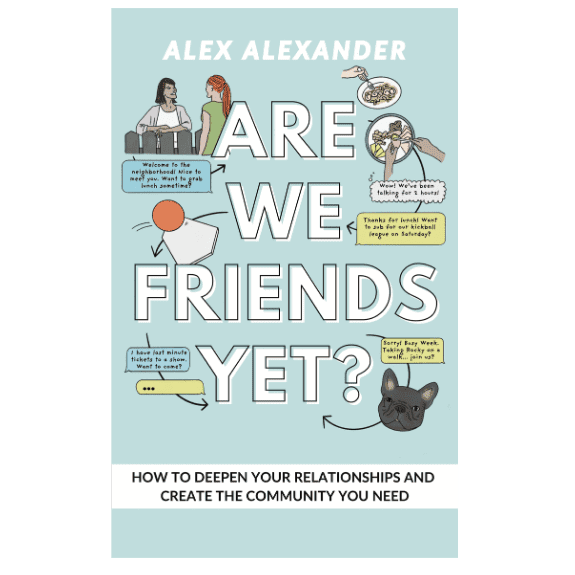
I’m also finishing my book, which includes the Wheel of Connection framework plus the Roots of Friendship framework and so much more.
If you don’t want to miss these, sign up for my newsletter. I don’t spam: just weekly stories and updates when new resources drop.
You can sign up at [your website link].
Thank you for being here for 100 episodes. Thank you for doing this work. Thank you for reimagining friendship with me.
Here’s to the next 100.
Want to go deeper into the Wheel of Connection? Sign up for my newsletter to be the first to know when the audio guide and book are released. I promise I don’t spam: just weekly stories and updates. [Newsletter signup link]
Did this framework help you see your relationships differently? Send me a voice message at alexalex.chat or DM me on Instagram @itsalexalexander. I’d love to hear what you noticed when you started mapping your own wheel.
Know someone who’s exhausting themselves trying to force a relationship to be a 10? Share this post with them. Maybe they need to see that their support can come from anywhere in their wheel. Not just the “right” places.
This episode is the 100th episode of Friendship IRL, and I put my whole heart into it. Listen to the full episode to hear the complete Wheel of Connection framework, plus stories and insights I couldn’t fit into this post. Whether you’re just starting to think about your friendships differently or you’ve been on this journey for a while, I think this one will meet you where you are.