This post may contain affiliate links, including Amazon affiliate links. If you make a purchase through these links, I may earn a small commission at no extra cost to you. I only recommend products and resources I genuinely use and believe in. Thank you for supporting Friendship IRL!
There’s a feeling a lot of us are carrying around right now that we don’t quite have words for.
Not depression. Not burnout exactly. Just… a low hum. A sense that you’re doing everything you’re supposed to be doing: keeping up, showing up, getting through it. Yet, something about the way you’re living feels off. Like you’re playing along with a version of life that isn’t quite working anymore.
If that’s you, I need you to hear this: that feeling is not a personal failure.
There are real structural, societal forces making connection harder than it has ever been. Most of us are moving so fast we don’t even stop to name them… we just feel the weight of them. Today’s guest has spent years studying exactly those forces, and she also happens to share a version of my own origin story in a way that made this one of the most personal conversations I’ve had on this podcast.
Stephanie Malia Krauss is an author, speaker, and strategist who works at the intersection of child development, social work, and what she calls rehumaning our lives: the active practice of protecting the best parts of being human when modern life keeps pulling us away from them. Her newest book, How We Thrive: Caring for Kids and Ourselves in a Changing World, is one of those reads that gives you language for things you’ve been feeling but couldn’t quite name. She’s spent her career working with kids and families from the classroom all the way to Congress, and she’s also the mother of a 13 and 15-year-old, which means she’s living this in real time.
In the second half of this episode, we get personal. Both Stephanie and I were raised by community in ways we didn’t fully understand until we were adults. And what we kept coming back to was this: you never know when your small act is the one that matters. The lacrosse jacket. The orange and the string cheese. The question someone asked that you never answered honestly, but never forgot.
This is that episode.
The Weather We’re All Living In
Stephanie opens How We Thrive with a framework that stopped me cold when I read it.
She calls it dangerous weather. Four forces that are all happening at once, creating conditions none of us were built to survive indefinitely:
- ▪️ Overtapped: never enough time or resources for what life is demanding
- ▪️ Overworked: chronic busyness, pressure to produce, the grind that never stops
- ▪️ Overstimulated: the real, documented impacts of addictive tech on our attention and anxiety
- ▪️ Overwrought: the existential dread that hums in the background some days and gets turned way up on others
Separately, each one is manageable. Together, they create what Stephanie calls a “compressed catastrophic living” effect, a wear and tear on our lives and our kids’ lives that most of us are too busy to even name.
“The biggest part for me in figuring out what was causing the deep depletion across adults and kids alike was understanding that those weather forces: being overtapped, being overworked, being overstimulated, being overwrought. They keep us from the good parts of the human experience. They actually pull us away from the human connections and experiences that we need and the conditions that we crave.”
This is what I mean when I say it’s not just you.
So much of what makes friendship and community feel hard right now isn’t a personal failure. It’s structural. It’s societal. And most of us are moving so fast we don’t even stop to give ourselves credit for surviving it.
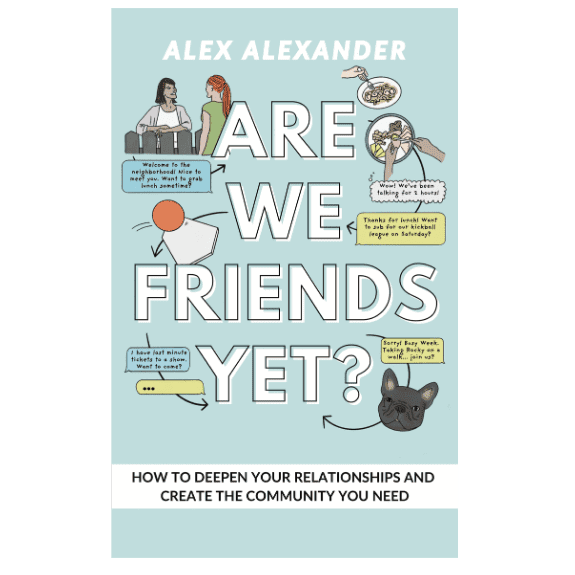
If you want the full aerial view of what we’re all navigating )parents, non-parents, caregivers, everyone) Stephanie’s book, How We Thrive, is the one-stop shop. And if you want the practical side: what to actually DO once you’ve said “okay, this is enough, something has to change.” That’s exactly what I wrote Are We Friends Yet? for.
The full episode goes much deeper into the dangerous weather framework, including Stephanie’s concept of allostatic overload and what it actually feels like in your body when you’ve hit your limit. Listen here.
What “Rehumaning” Actually Means
Stephanie got sober at 15. She’s been in recovery for most of her life. And the concept at the center of How We Thrive, rehumaning, has the same rhythm as recovery.
It starts with awareness: this isn’t how humans are meant to live and work and connect.
Then acceptance: I am living in 2026. This is our reality.
Then action: what is in my power to protect, given my actual life and constraints?
Rehumaning isn’t about a dramatic overhaul. It’s about asking, in the middle of the weather: what is the most human thing I can do right now? And then doing it.
For Stephanie, that looks like protecting what she calls the 14 human essentials. Things like play, wonder, belonging, creativity, connection, love. Not aspirational concepts. Actual capacities we’re born with that modern life keeps pulling us away from.
And here’s the part that hit me: she talks about telomeres, the caps on our DNA that determine lifespan. Chronic stress literally shortens them. But positive human connection? It can lengthen them. The science says that something as simple as really good friends, the kind who show up and say let’s just get Thai food tonight, can literally extend your life.
I’ve been in a lot of therapy. Every therapist I’ve ever had has said some version of: I don’t know how you’re doing as well as you are, given everything you’ve been through. The answer, every single time, is the people.
Raised by Community
Here’s where this episode gets personal.
Both Stephanie and I grew up in situations where our home lives were hard, really hard, and where the community around us showed up in ways we didn’t fully understand until we were adults.
Stephanie grew up in a small town, one of five kids, with parents who split early because of addiction and mental health issues. She became a caregiver young. She left home. And looking back now, she can map the people who kept her alive… not one hero, but a web.
Two moms who chipped in for a $35 lacrosse jacket so she’d have one like everyone else.
A pizza shop owner who defended her when a man leered at her.
A counselor who kept frosted animal crackers and an extra pair of clothes in her office, with a back door Stephanie could come through without anyone seeing.
“I saw somebody who every time I walked into that office, no matter how I looked, smiled, wanted to see me, believed I could have a future, and also fed me.”
She gave that counselor a copy of How We Thrive two weeks before we recorded this episode.
My version of this story looks different but rhymes. A friend’s mom who would always have a “special snack” waiting (an orange, a string cheese… nothing fancy) and would make me sit at the counter and talk before I could go play. I was annoyed by it as a kid. I know now she was checking in on me every single time.
Coaches who talked to each other about how I was doing. Parents who quietly figured out rides to rowing races and presented the plan to my dad without making it a thing. Adults who asked how things were at home, and who I always lied to, because I was scared of what the truth would mean.
But here’s what I’ve realized: every time one of those adults asked, even when I said everything’s fine, it opened a door. It said: if it ever gets so bad you can’t take it anymore, you have somewhere to go. I didn’t have one adult I could tell. I had twenty who had quietly made it known that the door was open.
In the full episode, Stephanie and I go deep into what it felt like to be raised this way, what we understand now that we couldn’t see then, and why these “small” acts were anything but small. Listen here.
Askables, Anchors, and Activators
Stephanie’s friend and colleague Jonathan Zaff has done research showing that every kid needs more than one caring adult. Not one hero who fixes everything. A web of support.
Stephanie breaks that web into three roles:
- ▪️ Askables: people you can go to with questions, and who will ask the questions back
- ▪️ Anchors: people who are just going to be there, steady, no matter what
- ▪️ Activators: people who bring new resources or opportunities to bear, using their own social capital to connect a kid to something they couldn’t reach alone
The thing about these roles is that you almost never know which one you’re playing.
You might think your role is peripheral. You’re just the friend’s mom who always has snacks. You’re just the coach who asks how things are going. You’re just the neighbor who keeps the door unlocked.
But you might be the central one. The one they remember for the rest of their life. The one who shows up in a book.
“You actually never know the role that you’re playing in somebody’s life fully, and what you’ll be asked to step into. You might think that you have a peripheral role as an auntie, but actually you’re playing a central part in that moment.”
You don’t have to be everything to everyone. You just have to keep the door open.
The Trap of Being Praised for Being “So Good at This”
One of the most uncomfortable moments in this conversation, and one I think is going to land hard for a lot of you ,was when we talked about the trap that caregivers fall into.
Not the obvious trap of burning out. The sneakier one: being PRAISED for it.
I was praised my whole life for being self-sufficient. Responsible. Always there for everyone. The one who dropped everything when someone needed her. I genuinely thought that was a positive trait. I thought it was a superpower.
It took me until my mid-twenties to realize I was doing it at the expense of myself. And it took my friends cheering me on… actually applauding when I said I’m too tired to cook tonight, we have to order something. To understand that the version of me that always shows up isn’t always the healthiest version.
The reason my friends cheered is because I had shared enough of my real story that they knew what they were rooting for. That’s not luck. That’s what happens when people understand your backstory. They know what to celebrate.
If you’re a caregiver by nature, by history, or by default: the dangerous weather Stephanie describes? You’re probably generating some of it yourself. The overtapped, overworked, overwrought feeling doesn’t always come from outside. Sometimes we’re doing it to ourselves, because we were wired young to believe that’s just what we do.
Stephanie calls this the internal weather we carry from childhood into adulthood. And it is its own kind of storm.
Why We Were Never Meant to Do This Alone
Stephanie has a line in How We Thrive that I keep coming back to.
Three hundred thousand years of human history. Other species had strength, stealth, speed. Humans had one thing: our ability to be social and connect. It’s the very fabric that allowed us to survive across millennia.
We were never meant to parent alone. We were never meant to go through life alone. We are a tribal people, and we’re living in an industrial, individualistic model that makes it increasingly hard to actually be that.
So if connection feels hard right now? That’s not a personal failure. That’s a structural one. And the antidote isn’t a bigger effort or a better strategy. It’s going back to what we were always made for: showing up for each other in the smallest possible ways, and letting other people show up for us.
The lacrosse jacket. The orange and the string cheese. The question someone kept asking even when you kept lying.
Those things add up. I’m proof. Stephanie’s proof.
You might be someone else’s proof right now, and not even know it.
If this episode hit home, listen to the full conversation here. Including Stephanie’s telomere research, the “bodies before bots” framework she’s using with her own teenagers, and what she told a room full of high schoolers about the journal she kept as a kid.
Think about one kid in your life, yours or someone else’s, who could use a door left open right now. What’s the smallest possible way you could open it?
And if this episode cracked something open for you, I want to hear about it. Send me a voice message at alexalex.chat or find me on Instagram @itsalexalexander. The conversation doesn’t have to stop here.