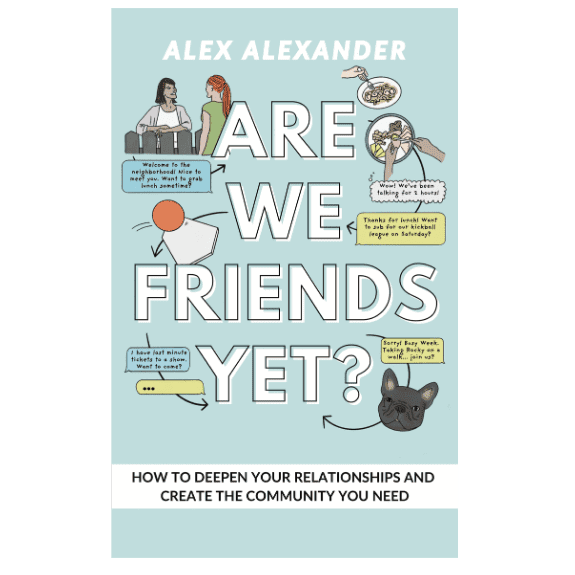
Are We Friends Yet? is out in the world.
I know that sentence looks clean. Simple. Like: she decided to write a book, she wrote it, she released it. But that is not what happened. Not even a little.
What actually happened is messier and far more human. I set out to write a 40-page ebook and accidentally wrote a book. I navigated a trio of chronic illnesses that shut everything down for nearly two years. I turned down a Big Five publishing deal 18 days before release because my gut said it wasn’t right.
And I cried on the floor more times than I’d like to admit.
This episode isn’t about the frameworks in the book or why you should read it. I’ll be doing plenty of that everywhere else. This one is for you… the people who’ve been here since episode one, or episode 50, or episode 130. You’ve been on this journey with me in some way, and you deserve to hear the real story.
So. Let’s go back to 2019.
Listen to the full episode here.
It Started With a Food Blog
In 2019, I was wrapping up my last season as a luxury wedding planner after nearly a decade. Burnt out, ready for something different. I started a food blog called The Eternal Hostess, the anti-Martha Stewart, basically. How to get people together. How to make it easy, casual, cheap. How to pull things out of the back of your freezer and feed 10 people on a Tuesday.
The blog was growing. Instagram Stories were rising. And people started showing up in my living room, virtually, watching our friend hangouts, our trips, our sweatpants parties.
That’s when the DMs started. Not about the food. About the friends.
“It’s really great that you can tell me how to cook dinner for 10 people at the last minute. But what I really want to know is… how do you have 10 friends?”
I genuinely didn’t know how to answer that, because I had never considered that other people didn’t have friendships like mine. Friendship wasn’t optional for me. It wasn’t a nice-to-have. I depended on it for survival. (If you want to understand why, go listen to Episode 19. That’s the episode where I really get into my family of origin story, and it explains a lot about why I approach friendship the way I do.)
I just thought everyone operated the way I did. Turns out: no.
The Business Friends Who Dared Me
Around this same time, I was part of a small group of five women who had originally met through a business networking group. We’d broken off on our own to meet weekly and basically serve as each other’s board of advisors.
They were the first people to say it out loud: “The things you’re saying about friendship are changing our lives. You should write about this.”
My immediate response was: who am I to talk about friendship on the internet? I’m not certified. I don’t have a degree. I’m not a therapist or a researcher.
They were not moved by this argument. They gave me a dare instead: Can you write 40 continuous pages about friendship? If you can, you probably have something to say.
I said okay. I thought it would be a small thing.
Reader, it was not a small thing.
The 40-Page Ebook That Became a 120-Page Word Document
It’s spring of 2020. The world has shut down. My entertaining blog is suddenly a very bad idea. I’m sitting at the dining room table across from my husband, and I think: fine, let me try the ebook.
I started in Canva. Early Canva. If you’ve ever tried to write anything of substance in early Canva, you understand the chaos. By the time I hit 30 pages, the whole thing had gotten unruly. I pulled it into a Word doc.
That’s when things exploded.
By fall of 2020, I’m in a house in Palm Springs with a group of friends. All of us co-working, all of us escaping the Seattle winter. I have photos of myself standing at the edge of the pool with an umbrella over my laptop, just writing. That’s where a big chunk of the early book got written: in a pool in Palm Springs, surrounded by the people I was writing about.
Then something happened that accelerated everything. Within about six months, five couples, ten of my closest friends, all moved away from Seattle. I had panic attacks. Real ones. Sunday dinners, trips, the whole ecosystem of my support system was about to change, and I was desperate to understand what was actually holding our friendships together.
So I spent hours thinking about it. Walks, staring at walls, talking to friends, talking to strangers at coffee shops. My ADHD brain, which I now know is a genuine superpower for pattern recognition, was synthesizing everything. And that’s where the Roots of Friendship framework came from. And once I had that, I realized it was connected to the Wheel of Connection. that the roots inform the wheel, and people can move around the wheel by building different roots.
By mid-2021, I had roughly 120 pages. Single spaced. In a Word document. Written with no outline, no thesis statement, no structure… just a brain dump of everything I had figured out about friendship.
I had absolutely no idea what to do with it.
The Part Nobody Tells You About Writing a Book
I went down a two-week rabbit hole learning how traditional publishing actually works. Lit agents. Query letters. Book proposals. I genuinely did not know any of this existed when I started writing.
At the end of those two weeks, I made a decision: I was going to self-publish.
Part of it was protecting the message. I had heard enough stories (true for some people, not for everyone) about books getting acquired and then either shelved or reshaped into something the author didn’t recognize. If someone had come to me and said “we love this, but can you make it specifically a book for women about befriending other women?” I would have been heartbroken. That’s not my book. My book is about how all of us can connect with each other. That premise isn’t negotiable for me.
So: self-publishing. Which meant finding about ten subcontractors, because the person who does developmental edits is not the same person who does copy edits, and the person who designs the inside is not the same person who designs the cover, and I had no idea how any of it worked.
I found my book shepherds. Sarah and Britt at SpoonBridge Press, and I found my illustrator in the most unexpected place: my friend Sheena, who I’d known for eight years as a work acquaintance, not a close friend. I messaged her on a whim asking if she knew anyone with a similar illustration style to hers. She got on a call with me, heard about the book, and said: “I don’t really do this for anyone else, but I’ll illustrate for you.”
That’s the kind of thing that keeps happening in this story. The right people showing up at the right moment.
The developmental editing process was, I will not lie to you, painstaking. My book team came back and said: Alex, we need to restructure the entire book. Your frameworks are brilliant but you wrote them in the order your brain conceptualized them, not in the order a reader can follow. We basically cut the book apart and pasted it back together over four or five rounds of edits. I cried. Multiple times. It was awful. And it made the book so much better.
If you want to hear more about the full journey of building this book, including what the frameworks actually are and how they connect, the full episode is worth a listen.
The Year Everything Stopped
Here is the part of the story I don’t talk about enough.
The entire time I was writing this book, I was getting sicker. Slowly, then all at once.
By end of 2023, I was losing four or more days a week to migraines that medication wouldn’t touch, nausea, crippling fatigue, brain fog so thick I couldn’t string sentences together. I was barely sleeping. I had been fighting through it for years without realizing how bad it had gotten, because it was such a slow progression.
I had to stop. Almost everything.
I spent the next year doing elimination diets, seeing specialists, trying protocols, tracking symptoms, desperate for an answer. In October 2024, I finally got diagnosed with a trio of chronic illnesses. (Episode 109 goes deep on this if you want to hear more about what that year actually looked like.)
It wasn’t until summer of 2025 that I could consistently wake up and show up. Get on camera without canceling. Record a podcast interview and actually finish it. Do one task without having to go back to bed.
I am so grateful I waited. I cannot imagine trying to launch this book while stuck in bed four days a week. The delay was awful and it was also exactly right.
Recording the Audiobook (And the Humbling I Did Not See Coming)
By fall of 2025, I’m back. Health is at a new baseline. I’m moving forward on the book. Cover design, interior design, audiobook.
I have recorded 182 episodes of this podcast. I am comfortable behind a microphone. I thought recording the audiobook would be fine.
I was wrong.
Recording an audiobook is an entirely different skill set. The cadence, the intonations, the precision. It’s nothing like podcasting. My first session was rough. Like, genuinely rough. I left that studio thinking: I don’t know if I can do this.
Session two was better. Session three better than that. By sessions four and five I was feeling good. And then I had to listen back to the entire thing at 1x speed (all nine hours, fifty-five minutes, and fifty-one seconds) to catch errors.
(Yes, I know that number. I will know that number forever.)
After listening back, I made the call: we had to re-record the entire first day. I sounded monotone, scared, stiff. So we did it again. And it’s good now. I’m proud of it.
The Book Deal I Turned Down
Here’s the part of this story that still makes my stomach flip.
Eighteen days before I was about to release the book… a date I had set, a date only my team and I knew about… I got an email from an editor at an imprint for a Big Five publisher.
A real offer. An advance. Copies. A full traditional publishing deal, sitting in front of me.
And I turned it down.
Everyone who had never had a book deal told me to take it. My gut said no. I was too far into the process. I believed in what I had built. And there’s a real conversation to be had about intellectual property when you’re a newer author, all of my core frameworks are in this book, and signing them over at the debut stage didn’t feel right.
I wrote an entire book proposal in one day, submitted it, got the formal offer, and said no. Then I picked a new release date.
(How do you pick a date to release something you’ve been working on for six years? You just… pick a day. You press publish. There’s no ceremony for it. You just go.)
Right or wrong. We’ll find out. But it felt right. And at this point, following my gut is the only consistent thread in this whole story.
So. What’s Actually in the Book?
Are We Friends Yet? is 15 chapters plus a bonus chapter you’re meant to come back to a few months after finishing. 312 pages. Nine hours, fifty-five minutes, and fifty-one seconds of audiobook.
It’s structured in three parts:
- ▪️ Part one is about where you are now. How you’re showing up, what you wish was different
- ▪️ Parts two and three are the frameworks: the Wheel of Connection, the Roots of Friendship, the four types of friends
- ▪️ The final part is about reimagining what you actually want. Not a dramatic overhaul, but a few small shifts with a real action plan behind them
The title, Are We Friends Yet?, comes from the thing I kept noticing: we have this black-and-white definition of what a friend is, and a lot of us are walking around feeling like we don’t have enough, when actually we’re surrounded by small pockets of connection that add up to something we never expected.
This book gives you the frameworks to see what’s already there. And then figure out what to do with it.
You can order it anywhere books are sold online, or request it at your local library.
How You Can Help (If You Want To)
I sent my friends a list of eight specific things they could do to support this launch. Because “I want to support you!” is sweet, and “here’s exactly what would help” is actually useful. So here’s the list, if any of it resonates:
- ▪️ Buy a copy and leave a written review — even two or three sentences on Amazon makes a real difference
- ▪️ Gift a copy to someone strategic — a librarian, therapist, HR professional, community leader, event planner
- ▪️ Make a warm intro — if you know someone I should connect with, send them my way
- ▪️ Request the book at your local library or bookstore — indie authors don’t automatically get shelved; a request from a patron gets us there
- ▪️ Nominate me as a podcast guest — if a podcast comes to mind where I’d be a good fit, comment my name, send a DM, email them
- ▪️ Reshare and engage on my socials — I’m putting out a lot of book content; any engagement helps
- ▪️ Suggest the book to a book club — and if you do, I will show up. In person if you’re in Seattle. Virtually, anywhere in the world. Check my website for how to book that
- And if you’re not buying the book but you’ve been listening to this podcast for a while: a written review of the podcast means more than you know. Not just stars — actual sentences. I can use those in press kits, on my website, in speaking pitches. If you want to keep it anonymous, I’ll keep it anonymous. Just send it my way.