Have you ever felt vaguely guilty about a relationship you couldn’t quite explain? Like, you know you should feel closer to your cousin. Or you know your sibling should be your person. Or you’ve been calling someone your best friend for years and quietly wondering why you never feel like you’re doing it right.
Sometimes the problem isn’t the relationship. Sometimes it’s the gap between the title you’ve put on it and what you’re actually living.
That’s what Episode 200 is about. And I have to say, the fact that this is the episode that landed on 200 feels like the universe was paying attention.
The Moment That Started This Episode
A few weeks before recording, I was at a networking event and had one of those rare aha moments about my own work. I finally landed on the phrase: “I help people make sense of their friendships.” And the second I said it out loud, people started coming up to me wanting to put it to the test.
One woman said: “Talk to me about cousins.”
And I thought, oh, I have a LOT to say about cousins.
Then, separately, I was doing a pre-episode call with a podcast host who mentioned her brother. She said something like, “He lives across the country, and that’s what I tell people. But the real answer is that this relationship has never felt aligned. Spending the holidays with him is the last thing I want to do. But people keep expecting us to be close because he’s my brother.”
Two different conversations. Same theme. The title on the relationship was creating an expectation that the actual relationship couldn’t meet. And nobody had the language to talk about that gap.
A Quick Primer on Story Roots (You’ll Need This)
If you haven’t heard me talk about my Roots of Friendship framework before, go back and listen to Episode 12 first. I give you a quick overview in this episode, but Episode 12 goes much deeper and it’ll make everything I say here land harder.
The short version: every relationship is held together by roots underneath the surface. There are three types: shared experience roots (what you do together), emotional intimacy roots (what you know about each other), and story roots (what you believe about the relationship).
Story roots are beliefs. And beliefs create expectations.
Here’s where it gets interesting: story roots form in three ways.
- A pattern of evidence builds over time. You keep experiencing something, and eventually you just believe it because you have so much proof.
- You choose a belief before the evidence is there. You meet someone twice and decide you’re going to be best friends. Sometimes that works. Sometimes you get burned.
- You inherited the belief from somewhere else. Family messaging, cultural messaging, media. You absorbed it, and now you’re carrying it around like it’s your own.
That third one is what this episode is really about. Because a title, like cousin, sibling, best friend, is an inherited story root. You didn’t choose it. It came with the relationship. And it brought a whole set of expectations with it that you may have never examined.
Run the Test
Think of a stranger sitting in a coffee shop. You’ve never met them. They tell you their best friend is about to show up.
What do you picture?
Do you assume they’ll hug? That they’ll pick up mid-conversation? That there’s a certain level of physical comfort? That they know everything about each other’s lives?
Now try it with a cousin. A sibling. A mother-in-law.
Notice what happens in your brain with each one. Because that reaction, that automatic picture that forms, that’s your story root. That’s the inherited expectation you’re carrying into every relationship with that title.
And here’s the thing: none of those pictures have anything to do with the actual people. They’re just the script the culture handed you.
Going Through the Titles
I spend a good chunk of this episode running through specific titles and unpacking the expectations that come with them. A few that are worth sitting with:
Cousins
The script usually includes: you’re close, you spend milestones together, there’s a certain family familiarity, you show up for each other. But what if you have zero shared experience roots and zero emotional intimacy roots with your actual cousin? What if you’re the only one putting in effort? What if the relationship you’re living looks nothing like the relationship the title implies?
Siblings
We have such a loaded cultural picture here. And it shows up in both directions. Sometimes people are carrying enormous grief that their sibling relationship doesn’t match the expectation. Other times, people borrow the sibling title to describe a friendship that HAS all the roots, because we don’t have better language yet. “She’s my friend, but she’s like a sister.” That sentence is doing a lot of work precisely because we don’t have words for what deep, rooted friendship actually looks like.
Best friends
I’ve talked about this one a lot on this show, but the title test is worth running here too. “Best friend” carries what I’d describe as a big, vague, overarching story root that implies unlimited, undefined obligations. And one of the most common things I hear is not “my best friend isn’t living up to the title.” It’s “I don’t feel like I’m living up to the title.” The expectation is so large and so undefined that people feel chronically like they’re failing at it.
In-laws
This one’s interesting because it comes with a negative default script. If someone in a coffee shop said “my mother-in-law is joining me,” there’s a societally acceptable version of “oh, is that a good thing?” that we’d probably reach for. The script comes loaded with tension before you’ve seen these two people interact once. And if that person said “I actually adore my mother-in-law, she’s my biggest cheerleader,” you’d probably say “wow, how lucky.” Because the negative script is that strong.
None of these scripts tell you anything about the actual people or the actual relationship. They’re just inherited story roots doing their thing.
Listen to the full episode at friendshipirl.com/episode200 for the complete run-through of titles, including the ones with NO script at all, and what it means when you’re navigating a relationship with zero cultural template to lean on.
The Titles That Are Starting to Shift
Something I find genuinely hopeful: the more we talk openly about how varied relationships actually are, the more the default scripts start to loosen.
“Husband” used to carry a pretty clear positive script. Now, because we’ve heard so many stories, because people are sharing openly about difficult marriages and healthy ones and everything in between, I think a lot of us have moved to something more like neutral. We don’t assume good or bad. We ask.
“Family” is going through something similar right now. Conversations about estrangement, about difficult adult parent-child relationships, about what it means to choose your family versus inherit it, those conversations are moving the script toward something more honest.
My hope? Friendship titles are next. The more we talk about how varied the lived experience of friendship actually is, the fewer assumptions we make, the less we judge ourselves when our experience doesn’t fit the box, and the more room there is for relationships to be what they actually are. That’s what this show is here to do.
What to Do With This
Know what expectations you’re holding. And then decide whether those expectations are serving you.
There are two types of awareness worth developing here.
Outward awareness is how your assumptions show up when you look at other people’s relationships. If someone tells you “my sister and I aren’t close” or “my best friend and I only talk a few times a year,” what’s your reaction? If you have a strong picture of what a title should look like, how does that color what you think of their relationship?
Inward awareness is where it gets personal. Do the titles people hold in your life match what you’re actually experiencing? If they don’t, are you trying to carry the entire load of making them match? And if a title doesn’t fit, is there a smaller, truer story root that could?
“My cousin and I have a lot of fun when we’re together” is a very different expectation than “my cousin will drop everything for me.” But it still allows for something real and positive. It’s just honest.
What I want for you is a chosen story root. One you actually picked, instead of one that just arrived with the title.
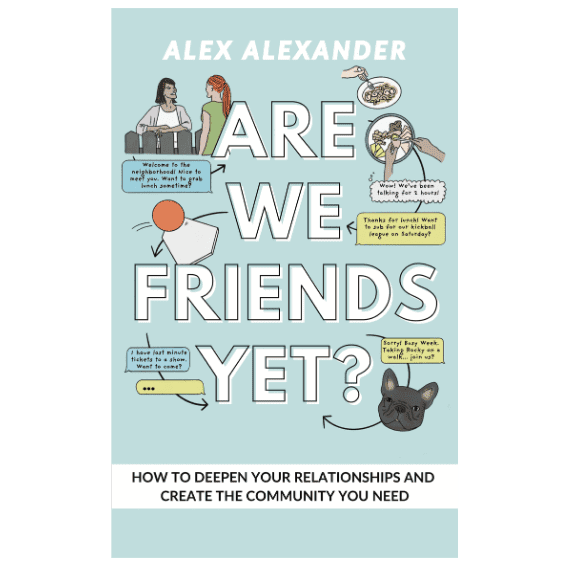
If you want to go deeper into story roots and how they’re shaping your relationships in ways you might not even realize, head to Episode 12 in the archives. And if you want the full framework, Chapter 8 of my book, Are We Friends Yet?, goes all the way in. Story roots show up across the whole book, but Chapter 8 is where I really dig into the beliefs and expectations underneath your relationships and what to do with them.
One Last Thing
Episode 200. I genuinely don’t know how I got here.
The goal has always been to give people language for what they’re already experiencing. To make it a little easier to look at your own relationships honestly, without judgment, and figure out what’s actually working and what isn’t. This episode is one of the clearest examples of that work.
And I’m not done yet.
If any of this landed for you, if you recognized a title in your own life that’s been creating a gap between the expectation and the lived experience, listen to the full episode at friendshipirl.com/episode200 for the complete reflection prompts and the full title-by-title breakdown.