I need to tell you about my friend Jenny Driezen.
We met on the internet. We’ve never met in person. She lives in Edinburgh, Scotland. I’m in Seattle.
And she’s one of the people I think about texting when something happens in my life.
We started following each other’s business accounts on Instagram. Messaging back and forth with things like “Hey, I can help you with that” or “I know someone for this” or “How’s your week going?” or “I just went through that problem last week.”
Business stuff. Helpful stuff. Friendly stuff.
But over time, it became more. We were sending “How was your week? What’s new with you? Those look like fun weekend plans!”
And then the Instagram one-minute voice memo limit started driving me nuts.
So I did the thing. I made the bold move.
I messaged her: “Hey, here’s my phone number. If you want to take this friendship off the app…”
She said yes. Obviously.
And now we just message like any other friend. Even though we’ve never met in person.
Don’t let anybody tell you that you can’t make real friends on the internet. You absolutely can.
And Jenny? She’s taught me more about community care than almost anyone else. Because she’s living it. She’s building Fresh Starts Registry with her sister Olivia (who’s also been on this podcast, Episode 68), creating a whole business around supporting people through life’s transitions.
But more than that, she’s someone who’s figured out that taking care of your community IS taking care of yourself.
And I want to tell you how she got there. Because her journey might just change how you think about friendship.
Jenny’s “Friendship Era”
When Jenny told me she’s in her “friendship era,” I immediately knew that was my new favorite phrase.
But getting there wasn’t easy for her.
“I grew up in a school environment where I didn’t really have a lot of friends,” she told me. “I always had my sister Olivia. We’ve always been really close. We never hated each other as sisters because of a lot of things we went through in our childhood.”
In high school, she struggled with female friendship in particular. “There was definitely some competition and jealousy that I felt. I just wasn’t really finding… I don’t know how to connect with people in that capacity with women.”
Her best friend in high school was a guy. Still is one of her closest friends.
In college, she had her first experience of really falling in love with a girlfriend. “That kind of ‘I showed up at her dorm, I had bought two pairs of shoes’ moment. We talked for five hours.”
That friendship? Eventually ended in heartbreak. The kind that still stings 10 years later.
“Since then, I’ve been figuring out what female friendship is,” Jenny said. “So much of it for me was removing myself from situations where I felt competitive with women. And removing myself from situations where I couldn’t assume somebody’s intentions were good.”
She had to learn how to be vulnerable. “I cry easily, but you can actually cry and not really share yourself with people.”
But when she opened that door? “The other side was just this amazing event that I had no idea was even possible.”
Now she has friends who’ve helped each other through divorces, breakups, big moves, falling in love again, IVF, job loss, staying in marriages, and working through hard things.
“I opened the door, and the other side was just this amazing event that I had no idea was even possible, because I wasn’t raised seeing that.”
And here’s what really got me: She told me about her husband.
“Falling in love with my husband, I said to him while we’re falling in love: ‘I’m so excited to see who I get to be in this relationship. Because I’ve never been loved like this before.’”
“And I can feel that, the way that he loves me, I pour into other people. I can feel that, plus the therapy and all the other stuff. But I can feel that.”
The love she receives doesn’t stay contained. It overflows into her friendships, her community, her work.
And that’s exactly what we’re going to talk about today.
In the full article, we’ll explore Jenny’s framework for community care as self-care, including an incredible story about her sister that will make you cry, and practical ways to show up for your community without burning out.
The Sister Story That Changed Everything
Before we get into the community care framework, I need to tell you this story.
When Jenny started writing her book (yes, she and Olivia are writing a book about Fresh Starts: proposal going in soon!), she was estranged from one of her sisters.
“We were not getting along. We couldn’t even sit through a meal together without hostility and aggression.”
And then Jenny started applying everything she was learning about friendship to that relationship.
“Everything I was learning reporting about friendship, I applied to my relationship with my sister.”
The result?
“We are now: I text her every morning. She calls me every morning. I see her every Sunday. We have transformed our relationship.”
From not being able to sit through a meal together to texting every morning and seeing each other every Sunday.
“This was someone I couldn’t even sit through a meal with. And now we seek each other out every single day.”
What changed?
“I just learned how to orient myself towards other people in a mature, loving, non-judgmental way. And it just opened up all these relationships for me.”
She paused. “I’m pretty low-key selfish. And it helped ME. So that’s why I’m so elated about the strategies, because they worked for me.”
If that transformation is possible with an estranged sister, imagine what’s possible with your friendships.
The Web (Not the Rope Bridge)
Here’s where Jenny’s thinking really aligns with mine (and probably why we became such fast friends):
She sees relationships as a web, not a rope bridge.
“I think it’s this continuous squeezy universe-shaped thing,” she said, laughing. “I don’t know what that thing is. I think maybe it’s a black hole. I don’t really know. I don’t know… that doesn’t seem like any of my business. Space? I got too much going on here.”
But here’s what she does know: “It all feeds each other. Community care and self-care and loving yourself and loving your people and accepting love and being able to accept love and being able to accept care and giving care.”
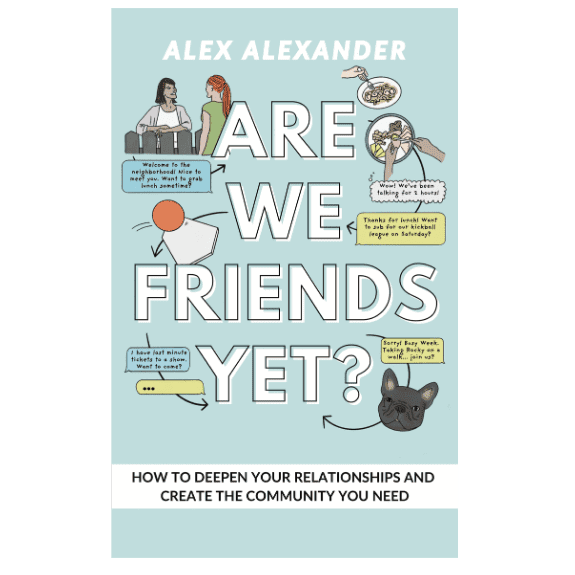
I actually have a diagram in my book about this. I call it a web too.
Because so much talk out there is about reciprocity: you give to me, I give to you, one-to-one.
But really? There are all these people. And when your husband pours into you, you have capacity to show up for your friends. Which helps your friends’ friends. Which might help their friends’ cousins’ brothers.
“A web is a very strong physical object,” Jenny pointed out. “It’s a very strong structure because it has all of these many little intersecting points. It’s not like a rope bridge. It’s a web, which is much stronger. So it can catch you.”
And that’s the key: When you contribute to the web, the web catches you when you need it.
In the full episode, Jenny talks about what it actually looks and feels like to see your relationships as a web instead of individual rope bridges. If you’ve ever felt exhausted by the pressure to maintain every friendship one-to-one, her framework will genuinely shift something for you.
Nourishment vs. Reciprocity
Jenny told me a story that perfectly illustrates why one-to-one reciprocity doesn’t work:
Her sister had babies. Jenny was home with her oldest when Olivia went back to work. She was 25 years old, and it was “such a great gift” to get to do that.
But Jenny realized: “She’s never going to be able to do that for me. My sister had her babies, I was home with her oldest. That simply wasn’t a reality. She was 25 before me. So when I have kids, she’s never going to be 25 again.”
“I think the best relationships are when two people believe they’re both putting in 100%,” she said. “It’s so hard to be a giver and be in any kind of relationship with a taker. If you are in a relationship with somebody and they’re not giving freely, it just doesn’t work.”
“If they’re counting, it will turn you (a giver) into somebody that is counting. And I don’t like myself when I’m in that position.”
Instead, Jenny thinks about it differently: “It is not a one-to-one. It is a web. You’re getting little pieces from everything.”
“The way that my husband loves me; but it’s also my husband saying to me, ‘Hey, I just want to be able to complain and not have you fix it.’ And then I take that lesson, and I can realize: Oh, when my friend’s talking to me, she’s not looking for me to fix it either.”
Lessons learned in one relationship transfer to others. Support received in one place allows you to give support elsewhere.
“There’s no direct ROI on investing in your community,” Jenny said. “There’s tons of ROI, but there’s no like, I dropped food off at the food pantry and then I feel so good because I get to see a kid skip in and get the cake mix I bought. It doesn’t work like that.”
“You are supposed to invest in your community because you want to give and you want to share what you can, while respecting and honoring your own boundaries.”
And that last part? That’s crucial.
The Moving Story (Or: When Helping Crosses Your Boundaries)
Because here’s the thing: Community care as self-care doesn’t mean being a doormat.
Jenny told me a story that taught her this lesson:
“I was once asked to help somebody move. My then-boyfriend and I went and helped somebody move. We drove my car into Queens. We helped them move all day.”
“We went out to lunch. And they didn’t cover lunch, which is not great. And then I got a ticket. I paid for the ticket.”
“I thought: This is a perfect example of me being like, ‘Oh, I still felt good that I helped her move. But I was like, I can’t do that again. Because I feel too much frustration and resentment.’”
Months later, that person asked her to help again.
“I was like, I don’t think I’m gonna be able to do that. I love this person. I helped them out in other ways. I did other things for them. I was able to show up for them.”
“But it was a perfect example of being like: There is a boundary. And I don’t want to show up in resentment for this person by betraying my own boundaries.”
This is so important. Because when we talk about community care, people sometimes hear: “Give endlessly. Sacrifice yourself. Be available for everything.”
That’s not what we’re saying.
We’re saying: Figure out what YOU can give. What feels good to you. What aligns with your capacity and your boundaries.
And then give THAT. Freely. Without keeping score.
In the full article, we’ll explore more about how to identify your boundaries and show up authentically. Plus, an incredible 15-year story about community care that will blow your mind.
The 15-Year Story That Proves It All
Jenny told me a story about her friend Maria that perfectly illustrates how community care comes back around.
Maria has a family member who requires more care. They get some support from the state: a person to help them out.
“Maria has been overseeing the care of this family member her entire life,” Jenny explained. “She’s always held a job. And then also had this second job: overseeing the care of this family member.”
She left her last job because it was bad for her mental health. Jenny was trying to help her find work, sending jobs her way.
Recently, Jenny texted: “What’s going on with jobs?”
Maria’s response? While she was off from work, she realized the state care wasn’t up to standard. So she called the caseworker and complained.
The caseworker said: “Will YOU do it?”
“Because she’d spent all these years collecting information and doing this community care (never expecting anything in return, never with that expectation, just because she loved this person) she is now being paid by the state to do the second job she’s always done as her unpaid second job.”
Being paid well. Getting to be with this person she loves every day. Making sure they’re taken care of properly.
“She’s like, ‘Do you know how much more free time I have?’ She has hobbies again.”
Fifteen years of unpaid care work. Fifteen years of showing up because she loved someone.
And then it all came back.
“She invested for literally 15 years, between being 15 and being 30, of taking care of this person. And then gets to actually have a life and make a salary and doesn’t have to go to a job where they’re being mean to her anymore.”
When Jenny called to ask if she could include this story in the book, Maria said: “We’re just making lunch.”
That’s what she was doing at noon on a Tuesday. Making lunch with the person she loves, getting paid to provide excellent care.
“All of the knowledge that she gathered, all the information, all the work that she’d done, came back to her,” Jenny said.
“To me, that’s the truest form of this. It all comes around.”
In the full episode, Jenny shares the full story of Maria and what 15 years of quiet community care built without anyone keeping score. If you’re someone who gives a lot and wonders if it’s even worth it, this story is the answer.
Why Internet Friendships Count
I want to pause here and talk about something Jenny said that I think is really important:
“Internet friendships get a really bad rap. I believe strongly in internet friends.”
“I have friends that are people that root for me more than my own family does. That I’ve never met in person.”
There was a tweet recently asking if anyone actually had an internet friend that lasted more than six months.
Jenny and Olivia’s response? “Yeah. 20 years. We’ve had internet friends for 20 years.”
“I have people that come and go, but they’ve made huge influences on my life.”
This matters. Because when we dismiss internet friendships as “not real,” we’re missing out on potential web connections.
Jenny lives in Scotland. I’m in Seattle. If we’d dismissed each other because we couldn’t meet for coffee, we wouldn’t have this friendship.
And recently? Something happened to one of my friends. I mentioned it to Jenny (without giving details). Just said they were going through something.
Her immediate response? “If there’s anybody in the Fresh Starts experts, or somebody I know, or podcast episodes, anything I could connect them to or resources I could give them: let me know.”
That’s her showing up in the way that feels good and easy to her. For MY friend. Who she’s never met. Who I love.
That’s the web. That’s community care as self-care.
Data Points, Not Judgments
One more concept from Jenny that I think is crucial:
She thinks about relationships in terms of data points, not judgments.
“Every piece of information you get is just a data point,” she explained. “There’s no judgment that comes with data points. We just observe them and say: How does that make me feel?”
“Two friends could say the same thing to me, and it will hit differently. That data point will be taken in differently because of all the other data points.”
She told me about a friendship that ended: “When this person said that final thing to me, I lined all of the data points up like gifts. Because they weren’t gifts… they were gifts about how she felt about me and what our friendship was.”
“All of these gifts that I can now go: Thank you for your time. That’s it for me right now.”
She ended that final conversation with: “Well, I’m gonna let you go. I love you. Bye.”
“And I did love them. And I knew that my heart would stop loving them at some point. It would let it go, become a thing of the past. And that was fine.”
“I can see it. I’m a very dramatic person. I can see the curtains literally come down on that person. They’re taking their final bow in my life. And that’s it for me.”
But here’s the important part: This isn’t about being cold or unforgiving. It’s about being honest with yourself.
“Loving people from a distance,” Jenny said. “Being like: We had our years together, we had our travels, we had our special things. And by being honest with ourselves, by recognizing that, by taking it into full account and observing all those data points: it actually honors the relationship more than pretending those things didn’t happen.”
Same Gift, Different Impact
Something else Jenny and I talked about that really resonated:
The same gift from different people hits differently.
I gave her an example from my book-writing process (which has been one of the hardest things I’ve ever done).
I have different people who tell me they’re proud of me. They might use the same words. But it lands differently depending on their context.
My friend Danielle, who lives nearby and has literally watched me edit at her kitchen table? When she says she’s proud of me, it hits because she’s SEEN me want to pull my hair out.
But Danielle doesn’t write books. She’s in finance.
Jenny, on the other hand, is also writing a book (with her sister). When she says she’s proud of me, it hits differently because she’s IN IT.
She knows what 14,000 copy edits feels like. (Yes, that’s how many I got back. Jenny had 594 in just the first chapter of her proposal.)
I have another friend who thinks it’s cool I’m writing a book but has no concept of what that takes. When they say they’re proud of me? I appreciate it. But it hits differently.
“Same exact gift,” Jenny said. “But it lands differently based on the context and the experience.”
“If you picture your heart as this 3D object, there’s no amount of love that’s too much for your heart. There’s no amount of pride and good feelings that’s too much.”
“We’re just all getting it from different angles. Hopefully what ends up happening is you tell five people, and your heart is now going to be completely ensconced in love. Every little angle of your heart is going to get a little bolt of love and lightning to it.”
That’s why we need variety in our friendships. Because different people fill different angles.
What This Actually Looks Like
So what does community care as self-care actually look like in practice?
Jenny gave me a perfect example from earlier that day:
“I started my morning and I was like: I owe three people testimonials for working with them. I went to the coffee shop and I wrote three testimonials. I sent them out.”
“This is community care as self-care. I sent them out because I owe them testimonials. And I got the best emails in response of them being so grateful.”
“That is my gift. That is my self-care. I feel great.”
She paused. “There is no such thing as a selfless act. Even when we do something and we spend money and we give, there’s still a little bit of you that feels good.”
“And that’s okay. That’s good. It makes us want to do it more.”
It’s not the motivation. But it’s a wonderful byproduct.
And here’s what’s crucial: Jenny wrote testimonials because that’s something she can do. That’s her gift. That’s in her capacity.
She’s not trying to help everyone with everything. She’s showing up in the ways that feel authentic to her.
And that’s what makes it sustainable.
The Small Intimacy at the End
Near the end of our conversation, Jenny said something that made me smile huge:
“I don’t know you very well yet, Alex Alexander. But I believe that in 30 years, I’m going to. And I believe that I’m still going to know you.”
If you’ve listened to Episode 74 about small intimacies, you know why this made me light up.
That’s a small intimacy. A small moment of vulnerability.
Jenny was saying: Hey, I really like this friendship. I hope we’re friends 30 years from now.
That’s vulnerable to admit upfront. You’re putting yourself out there.
And I immediately catalogued it. Smiled. Thought: I hope we’re friends 30 years from now too.
That’s what friendship looks like. Small moments of “I see you and I want you in my life.”
The Permission You Need
If you take nothing else from this article, hear this:
Community care doesn’t mean sacrificing yourself. It means showing up in ways that feel authentic to you, respecting your boundaries, and trusting that the web will catch you when you need it.
You don’t have to help everyone with everything.
You don’t have to say yes to every request.
You don’t have to give until you’re depleted.
You DO need to figure out what YOU can give. What feels good. What aligns with your capacity.
And then give that. Freely. Without keeping score.
Because here’s what Jenny and I both know: When you invest in your community in ways that feel authentic to you, you’re not just helping others. You’re nourishing yourself.
The love you give doesn’t disappear. It creates a web that holds you. It comes back in unexpected ways from unexpected places.
Like a friend you met on the internet who lives across an ocean but shows up for you and your people anyway.
That’s community care. That’s self-care. That’s the web.
In the full episode, Jenny and I talk more about internet friendships, what community care actually looks like in daily life, and why the small moments of “I see you” matter more than we think. If you want to feel more connected without overhauling everything, go listen to the complete episode.
Want to learn more about supporting people through life’s transitions? Check out Fresh Starts Registry and follow Jenny and her sister Olivia’s work. Listen to Jenny’s sister Olivia on Episode 68 of this podcast, or hear my conversation with both of them on their podcast “A Fresh Story.”
And grab their scripts for supporting people through hard times – they’re game-changers when you don’t know what to say.
Who’s in YOUR web? And how are you showing up in ways that feel authentic to you?