Let me guess: You’re the friend everyone calls when they’re going through something.
The one who drops everything to listen. The one who holds space for the deepest, hardest stuff. The one who never judges, never reacts, just… listens.
And you’re exhausted.
Because it’s always you doing the listening. You’re doing the holding. You’re showing up for everyone else’s hard moments.
But when YOU need support? Crickets.
Or worse: when you do try to share, your friends immediately make it about them. Or try to fix you. Or give you advice you didn’t ask for. Or just… don’t know how to hold you the way you hold them.
And maybe you tell yourself it’s fine. Maybe you even brag about it. About how good you are at being there for people, about how everyone trusts you, about how you can handle anything.
But deep down? You’re lonely. And resentful. And wondering why your friendships feel so one-sided.
Here’s what I need to tell you, and I need you to really hear this:
The one-sided dynamic in your friendships? You’re creating it.
Not because you’re doing anything wrong. Not because you should feel guilty. Not because you’re a bad friend.
But because you’ve patterned yourself as “the listener” and you’re actively blocking yourself from receiving.
I know that’s hard to hear. I know it might make you defensive. But stay with me.
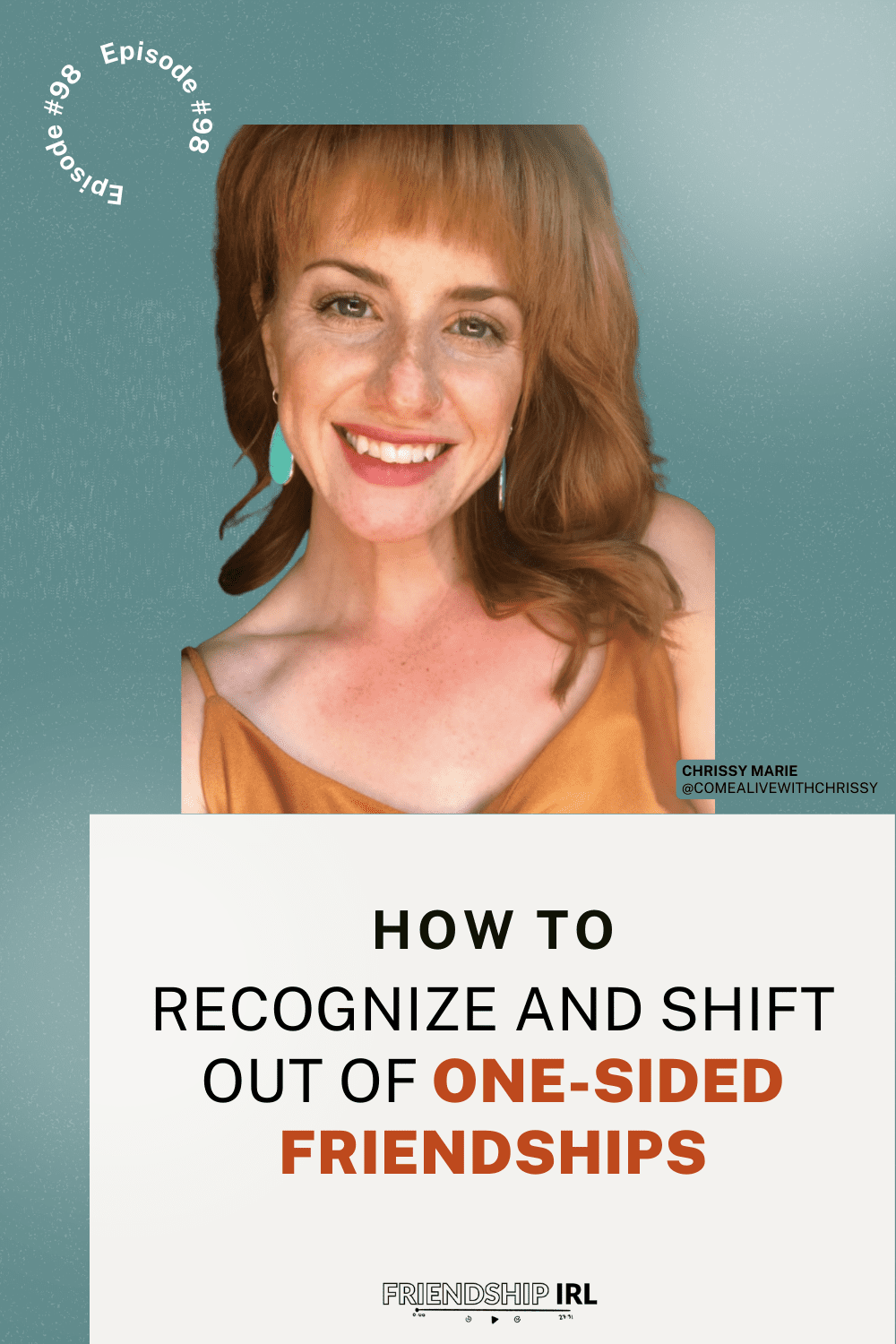
Because I’ve been there. And so has today’s guest, Chrissy Marie. And what we both learned is this:
The solution to one-sided friendships isn’t finding new friends. It’s doing the internal work to let yourself be held.
The Pattern: How We Become “The Listener”
Chrissy Marie is a trauma-informed embodiment practitioner and inner child liberator. She helps high-achievers grow up their inner people-pleaser and take themselves less seriously.
And for years, she was stuck in the exact pattern I just described.
Here’s how she explained it to me:
“Part of my conditioning growing up was I learned to pattern being a space holder, being a really deep listener, being a safe person for other people, with intimacy and connection.
Because I was able to hold space for a lot of people’s range and different experiences, and I wasn’t very reactionary, people would open up to me. And in that opening, I felt a lot of connection and intimacy.”
Sound familiar?
You learned early on that if you could be calm, steady, and non-judgmental, people would open up to you. And in their opening, you felt close to them.
So you anchored into that role. You became “the listener.”
But here’s where it gets tricky:
“I never really learned or felt safe in allowing other people to hold ME,” Chrissy said. “I didn’t know how to ask for what I needed. And it wasn’t immediately offered, so I didn’t even know exactly what it was that I needed.”
This is the trap.
You’ve become so good at holding space for others that you’ve forgotten (or never learned) how to let others hold space for you.
And the longer this goes on, the more entrenched the pattern becomes.
What This Actually Looks Like (And Why You Might Not Recognize It)
Here’s the thing about being “the listener”: it doesn’t always look like what you think.
You might actually be pretty open. You might share a lot about your life. You might tell people what’s going on with you.
But you’re not actually letting them IN.
Chrissy explained this so perfectly:
“I am quite and have been an open book. I would share some pretty deep things. I wouldn’t hold back on context. It was the FELT SENSE. It was allowing people to see me in a state of nervous system dysregulation that I was not allowing.
I would let people know of things that happened to me and things I was contemplating. People knew. They just couldn’t FEEL me because I wasn’t feeling in front of anybody.”
Read that again.
You can share all the facts of your life: the hard things that happened, the challenges you’re facing, the decisions you’re making.
But if you’re not letting people see how it’s actually affecting you? You’re not being vulnerable. You’re still performing.
Here are some other ways this pattern shows up:
You Lead With Your Trauma
Chrissy shared this one, and it hit me hard:
“In partnership and in some friendships, I would lead with my trauma in order to create connection. I’m leading with my trauma so that you feel safe to share with me, so that I feel close to you.”
You use your past pain as a way to create intimacy. But it’s controlled intimacy.
You’re sharing the story, but not the current feeling. You’re letting people know what happened, but not how it’s affecting you NOW.
It feels like vulnerability. But it’s actually a way to avoid it.
You’re Always Fixing, Never Just Witnessing
When your friends come to you with problems, you listen. You empathize. You try to help.
But when they try to do the same for you? It doesn’t feel right.
They’re giving you advice when you just need to be heard. They’re trying to fix you when you just need to be witnessed. They’re making it about them when you need it to be about you.
But here’s the question: Have you told them what you actually need?
Or are you expecting them to just… know? To magically provide what you’ve never asked for?
You Don’t Know HOW to Ask for What You Need
This is the core issue.
“I didn’t know how to ask for what I needed,” Chrissy said. “Nor did I really even feel safe in revealing the depths of my discomfort or my pain.”
You’ve spent so long being the strong one, the stable one, the listener. You don’t even know what receiving support would look like.
And even if you did, you’re not sure you’d feel safe asking for it.
Because what if they can’t give it to you? What if you open up and they don’t know how to hold you? What if it’s more painful than just keeping it to yourself?
So you don’t ask. You don’t share. You keep it inside.
And you wonder why your friendships feel one-sided.
The Watershed Moment: When Everything Shifted
For Chrissy, the turning point came at a leadership weekend: an intense somatic processing event.
“I had an experience of crying so hard (visceral sobs) in front of a room full of people I just met a couple of days prior. And I felt that unconditional acceptance. That sense of: I don’t need you to be different, Chrissy. I don’t need you to be the strong one, the stable one, the calm one. It’s okay to be exactly where you’re at right now.
That rewired something in my brain around intimacy and safety when it came to opening and sharing myself like that in front of other people.”
She experienced what it felt like to be truly held.
Not fixed. Not advised. Not told she should feel differently.
Just witnessed. Just accepted. Just held.
And it changed everything.
My Own Realization (Because I’ve Been There Too)
I need to be honest with you: I’ve been in this exact pattern.
For years, I prided myself on being the friend who would drop everything. Who could handle anything. Who was always there.
And I was resentful as hell because it felt so one-sided.
But here’s what I had to face: I was creating that dynamic.
I wasn’t setting boundaries around my capacity. I wasn’t asking for what I needed. I wasn’t letting people see me struggle.
I was controlling the intimacy by always being the giver, never the receiver.
And when I finally started doing the work to shift it. When I started being honest about my capacity, asking for specific support, letting people see me in hard moments… You know what happened?
Not a single friend pushed back.
They actually APPLAUDED me. They’d been watching me overextend myself for years. They WANTED me to take better care of myself.
The one-sided dynamic? I’d been maintaining it. Not them.
The Unraveling: How to Actually Shift This Pattern
Okay, so you recognize yourself in this. You see the pattern. You get it.
Now what?
Here’s what Chrissy and I both learned: This isn’t about finding new friends. It’s about doing internal work so you can show up differently in the friendships you have.
Step 1: Do the Inner Work (This Is Non-Negotiable)
You can’t receive from others what you can’t give yourself.
If you don’t feel safe with your own vulnerability, you won’t feel safe being vulnerable with others.
For Chrissy, this meant deep inner child work:
“I went through a pretty powerful process in my early 20s around connecting to my inner child. I would journal with her. I would sit in front of the mirror and have conversations. I would let her speak, and then I would ask questions.
There were many moments where I met the edges of myself. Parts of me that were like: is it okay to scream? Is it okay to cry? And I started building a connection to the part of me that knew how to hold the rest of me.”
For me, it was regular therapy. For you, it might be something else.
But the point is: You need safe containers where you can practice being held.
Places where you can let yourself fall apart and know you’ll be caught. Where you can express the full range of your emotions without judgment.
Because if you don’t have that internal safety, you’ll never feel safe opening up to friends.
Step 2: Learn What You Actually Need
Here’s a hard truth: You can’t ask for what you need if you don’t know what that is.
For Chrissy, the turning point came when she started paying attention to what actually felt good when people held space for her:
“I learned that trying to be the fixer wasn’t actually supporting people around me. And that’s when I realized: oh, that’s what I need. That’s what I want. I just want somebody to sit with me and say ‘I see you, and your emotions are not a burden, and I don’t need you to be any different. Let me know what you need to hear from me.’”
So start paying attention.
When friends DO show up for you, what feels good? What doesn’t?
When you’re struggling, what do you actually want? Just to be heard? To be validated? To get advice? To problem-solve together? To be distracted?
Get specific. Because “I need support” is too vague.
Step 3: Ask For It Explicitly (Don’t Make Them Guess)
Once you know what you need, you have to actually ASK for it.
This is where most people get stuck.
We think our friends should just know. We drop hints. We hope they’ll figure it out.
But that’s not fair. And it doesn’t work.
Here’s what Chrissy started doing:
“If I want to share with somebody, I’ll ask: ‘Hey, I’ve got some stuff. I don’t need advice. It would be nice to hear that what I’m feeling makes sense. Are you willing to listen for five minutes and then offer that as a reflection?’”
See how specific that is?
She’s not just saying “I need to vent.” She’s saying exactly what she needs and asking if they can provide it.
And you know what? Most people WANT to show up for you. They just don’t know how.
So tell them.
In the full episode, Chrissy and I share even more about what it looks like to start asking for what you need (and how to handle the vulnerability that comes with it). If you’ve always been the listener in your friendships, this conversation will feel like someone finally sees you.
Step 4: Build Diverse Support (Don’t Put It All On One Person)
Here’s something else Chrissy said that’s crucial:
“There are different levels of friendship.”
You have friends you go hiking with. Friends you play board games with. Friends you call when you need deep space-holding.
Not every friend needs to be everything.
And honestly? Some of your best “hold space” friends might not be your closest friends.
Chrissy has structured monthly Zoom calls with people where they share what they’re stretched by, insights they’ve had, and things they’re celebrating.
“That’s the extent of our relationship. And it’s so fulfilling. We just take turns and witness each other.”
These aren’t her closest friends. But they provide something specific she needs.
I have a similar dynamic with an internet friend I’ve never met in person. We hold space for each other beautifully. That’s what our friendship is for.
And that’s okay. That’s actually ideal.
Because when you have diverse support, you’re not putting all the pressure on your closest friends to be everything.
The Practical Strategies That Actually Work
Okay, let’s get tactical. Here are some specific things Chrissy (and I) have done to shift this pattern:
Strategy #1: Host Structured Gatherings
Chrissy started hosting fire circles at her house:
“I would invite friends over with the very clear expectation that nobody’s fixing anybody. There’s nothing that needs to be changed. We’d gather around a fire, I’d guide them through a meditation, and then we’d share what we’re looking to embody and what’s challenging us.
For me, this was a practice of facilitating a space with clear boundaries AND being witnessed as part of that. I was setting the standard of: nobody’s going to offer me advice. We’re all just going to take turns and be seen.”
She created a container where she could practice receiving while also giving.
Strategy #2: Use Structure for One-on-One Support
Here’s a format you can use with friends:
Pick 3 questions. Answer them every time you connect. Do it on a regular schedule (weekly, monthly, whatever).
Example questions:
- ▪️ What am I celebrating?
- ▪️ What am I being stretched by?
- ▪️ What insight have I had recently?
The structure makes it safe. Everyone knows what to expect. There’s no pressure to perform.
Strategy #3: Trade Space-Holding Sessions
Chrissy does this with several friends:
“I started to meet people who were a match in terms of that skill and capacity. We have agreements where it’s like: if you need me to hold space for you, you don’t need to pay me. I’m going to keep a session with you in retainer. We just exchange these space-holding calls.”
You hold space for them for one month. They hold space for you the next.
Clear. Structured. Reciprocal.
Strategy #4: Create a Document of Questions
If you struggle with small talk or don’t know how to connect beyond “the listener” role, do what Chrissy does:
“I have a document of questions that I pull out when I’m feeling rusty. Questions that lead conversations into people’s passions, what they’re creating, what they’re excited about. The last time they felt most alive.”
Set yourself up for success. Give yourself tools.
Strategy #5: Embrace Small Intimacies
This is something I talk about all the time: vulnerability doesn’t always have to be big and heavy.
Small intimacies matter too:
- ▪️ Sharing a silly story from your day
- ▪️ Admitting you’re tired
- ▪️ Saying “I’m not up for that tonight”
- ▪️ Inviting someone into your messy house
- ▪️ Being playful and weird
These are ways of letting people in that don’t require deep trauma processing.
And sometimes? These small moments build more intimacy than the big ones.
What About When Friends ARE Taking Advantage?
I know what some of you are thinking:
“But Alex, my friends really ARE just takers. This isn’t about me blocking myself. They genuinely don’t show up.”
And you might be right.
There are absolutely people who will take and take and never give back. Who will use you as their therapist without ever checking in on you.
But before you assume that’s what’s happening, ask yourself:
- ▪️ Have I explicitly asked for what I need?
- ▪️ Have I set boundaries around my capacity?
- ▪️ Have I let them see me in vulnerable moments?
- ▪️ Have I given them a chance to show up differently?
If you’ve done all that and they still don’t show up? Then yes, that’s a one-sided friendship that might need to end.
But in my experience? Most of the time, we haven’t actually done those things.
We’ve been performing. Controlling. Blocking. And then resenting our friends for not magically knowing what we need.
That’s not fair to them. Or to us.
The Truth About This Work
I need to be honest with you about something:
This work is slow. It’s hard. It’s ongoing.
Chrissy said it perfectly: “It’s still very much in it. There are still parts of me that kind of quiver around depth of connection. Like: is this okay to feel this big for somebody?”
Even after years of work, it’s still vulnerable. It’s still scary.
But you know what else is scary? Spending your whole life being “the listener” and never feeling truly seen or held.
You know what’s exhausting? Always giving and never receiving.
You know what’s lonely? Being surrounded by people who love you but don’t actually KNOW you because you won’t let them in.
That’s scary too. That’s exhausting too. That’s lonely too.
So you’re going to be uncomfortable either way. Choose the discomfort that leads to deeper connection instead of the discomfort that leads to isolation.
Where to Start (Just One Small Thing)
If you’re reading this and recognizing yourself, here’s what I want you to do:
Pick one small way to practice receiving this week.
Maybe that’s:
- ▪️ Asking a friend explicitly for what you need (“I just need you to listen for 10 minutes, no advice”)
- ▪️ Letting someone see you cry or struggle
- ▪️ Admitting you don’t have capacity to hold space right now
- ▪️ Sharing a feeling, not just a fact
- ▪️ Accepting help when it’s offered instead of saying “I’m fine”
Just one thing. One small practice.
Because this isn’t about overhauling all your friendships overnight. It’s about slowly, gently learning to receive.
And as Chrissy reminded me: “A lot of people don’t have role models of what healthy relating looks like. That’s why therapy or coaching or whatever… finding your person… is so important.”
You might need professional support to do this work. And that’s okay.
In fact, that’s beautiful. That’s you taking yourself seriously enough to get the help you need.
The Beautiful Truth On The Other Side
Here’s what I want to leave you with:
You are not broken for being “the listener.” You developed that pattern for good reasons.
Maybe it was the only way you knew how to connect. Maybe it was the only way you felt safe. Maybe it was modeled for you.
But it’s not serving you anymore.
And the beautiful truth is: When you start doing the work to receive, your friendships don’t get worse. They get better.
When you set boundaries around your capacity, your friends respect them.
When you ask for what you need, your friends are relieved to finally know how to show up.
When you let yourself be held, your friends feel honored to hold you.
The one-sided dynamic you’ve been stuck in? It can shift.
Not by finding new friends. Not by cutting people off. Not by being resentful.
By doing the internal work to feel safe receiving. By learning what you need. By asking for it explicitly. By building diverse support.
It’s slow work. Hard work. Ongoing work.
But it’s worth it.
Because on the other side of this pattern is something you’ve been craving your whole life:
Friendships where you can finally, truly, be held.
Want to hear the full conversation about breaking through one-sided connections? Listen to my episode with Chrissy Marie on Friendship IRL wherever you get your podcasts. We go even deeper into the internal work, share more practical strategies, and talk about the role of play and small talk in building reciprocal friendships. Subscribe so you don’t miss future conversations.