You know this person.
You’ve known them for months, maybe longer. You see them at the same places. You genuinely light up when you spot them across the room. You make a point to walk over. The conversation is always good.
And yet… nothing moves. Nothing changes. They’re not really a friend. But calling them “just an acquaintance” doesn’t feel right either.
This is one of the most common and least-talked-about frustrations in adult friendship. Not a falling out. Not a blowup. Not loneliness, exactly. Just a friendship that feels permanently stuck in some in-between place you don’t have a name for, and no idea how to get out of.
That’s what this episode is about. Not a pep talk to “put yourself out there.” A ROADMAP. The actual steps, in order, for how to move a stalled friendship forward without it feeling like a weird, high-stakes leap.
If you’ve ever had a familiar face in your life that you kept meaning to do something about (and never did) listen to Episode 177 of Friendship IRL here.
The Real Reason Your Friendship Isn’t Progressing
Most people’s first instinct when a new friendship stalls is to assume something is wrong. Wrong chemistry. Wrong timing. They don’t like me enough. I’m not interesting enough.
Here’s what I’d actually argue: the reason is almost never any of those things. The reason is that nobody taught us what friendship actually requires to move forward. We just expect it to happen, and as adults, that expectation is a recipe for staying stuck.
When we were kids, we didn’t need a map. We were thrown together in classrooms and soccer practices and gym class. We looked awkward in front of each other constantly. We took risks without even registering them as risks. We had proximity and repetition built in.
Now? Most of us are buttoned up. Showing up with our best foot forward. And we have a LOT competing for our attention. So that natural progression from I really enjoy this person to I consider them a real friend just… doesn’t happen on its own anymore.
And when it doesn’t happen, we either wait indefinitely or we make some big, out-of-nowhere move that feels genuinely risky. (You’ve met this person twice. You say: “Hey, I really enjoy you, want to get coffee?” It’s not wrong. It’s just a lot. And most people won’t do it.)
The missing piece isn’t courage. It’s the map.
Why “Friend or Acquaintance” Is Keeping You Stuck
Here’s the vocabulary problem underneath all of this.
Most people operate on a binary: someone is either your friend or they’re not. And anyone who hasn’t crossed into “friend” territory yet gets lumped into one flat category, acquaintance, with no roadmap for how to get from there to somewhere better.
As Alex puts it in the episode:
“There’s two options, friend or acquaintance, that’s it. And I actually think that’s causing us a lot of damage, because it means anyone who isn’t already a close friend gets lumped into one bucket. They get flattened, and there’s really no roadmap of how to get from one bucket to another.”
This is where the Wheel of Connection framework comes in. (If you haven’t heard of it yet, go listen to Episode 100 before you keep reading. It’ll make everything below land harder.)
The Wheel of Connection gives you more stopping points between “acquaintance” and “present friend”, the people you firmly consider your actual friends. In between those two poles, there’s a whole spectrum:
- ▪️ Familiar friend
- ▪️ Defined friend
- ▪️ Present friend
- ▪️ Historic friend
That person you keep seeing at school pickup, at your yoga class, at the networking event? They’re probably not an acquaintance. They’re likely a familiar friend, and that’s a meaningfully different thing.
Here’s the distinction. Imagine you walk into a party where you don’t know anyone. Every new face you meet that night? Acquaintance. You know their name, maybe why you’re both there. That’s it.
But in the back corner, you spot Ronnie and Esther. You’ve met them a few times before. You know Ronnie is really into drawing. You know Esther went to college with the host. You’ve had genuinely fun conversations with both of them. You KNOW you’re going to enjoy talking to them. They light up when they see you.
That’s a familiar friend. That is not the same as an acquaintance.
Alex had this happen recently at a networking event she almost dreaded walking into. She turned around after getting her name badge and there was Irina, a woman she’d met maybe four or five times. Didn’t have her number. Didn’t know her last name. But knew what city she lived in, what she did for work, that she was neurodivergent, that she’d had a recent business launch.
“When I walk into that room, she is a familiar face that makes me feel more comfortable like I am not alone.”
You’re probably further along than you think. The problem isn’t that you’re starting from zero. The problem is you haven’t been able to see the progress you’ve already made, because you didn’t have language for it.
The Roots Framework: Why Friendships Actually Deepen
(This section pairs with Episode 12, which is the full breakdown of the Roots of Connection framework. Go listen if you want the deep version. What follows is the compressed one.)
Every friendship is held together by roots. The more roots, the stronger the connection. When a friendship stalls, it’s almost always because you’ve been circling the same roots over and over without adding new ones.
There are three types:
Shared experience roots. The built-in reasons you’re in the same place. The mutual friend, the yoga class, the networking group. These are usually the ONLY roots a familiar friend has. You’re connected because of a context. That context keeps you orbiting each other. But if you just keep showing up to the same place, you’re not adding roots, you’re just reinforcing the one you already have.
Emotional intimacy roots. The small details you know about each other. The memories you’ve made. The inside moments that accumulate. This is NOT about deep confessional sharing. It’s Ronnie likes blue and chocolate chip cookies. It’s knowing your networking friend has a big launch coming up. It’s remembering that someone mentioned they were looking for a good Italian restaurant two months ago. Small things. Specific things. Things that say: I was paying attention.
Story roots. The beliefs you hold about each other. This person cares about me. This person thinks of me. This person shows up. With a familiar friend, these are thin, and that’s normal. But they grow from the other two. Every time you act on what you know about someone, you’re planting a story root.
The Ronnie example in the episode makes this vivid. You meet Ronnie in algebra class. You learn he’s struggling. You both try out for soccer. You learn he likes blue and chocolate chip cookies and is terrified of parallel parking. You show up to his birthday with blue balloons and cookies. His mom invites you over. You learn what snacks he keeps in his house. You develop a belief: Ronnie knows me. I know Ronnie.
None of those were big moments. They were a slow accumulation of small ones, each one adding a root, each root making the friendship more stable, each stable root making it easier to take the next small risk.
That’s how every close friendship you have was built. You just forgot, because it happened a long time ago.
The Actual Steps (In Order)
Here’s the map. And yes, order matters. Skipping steps is one of the most common ways a progressing friendship gets derailed.
Step 1: Build a new shared experience root
The first move is almost always creating a new reason to spend time together, one that is low pressure and adjacent to how you already know each other.
If you’re in a running group together: “Hey, I’m going for a run on Saturday. Want to join?”
If it’s a work colleague: “I’m grabbing coffee at 10. Want to come?”
If it’s the other parent you see at the park every week: exchange numbers and start a no-pressure text thread. “We always seem to be here at the same time… want to just text when one of us is heading over?”
The key is that it feels like a natural extension of the connection you already have. Going straight from post-spin-class chat to “want to get dinner sometime?” is a bigger leap than it sounds. Going from post-spin-class chat to “want to grab lunch right after?” is barely a leap at all.
You’re not asking them to be your friend. You’re just creating one more reason to be in the same place.
Step 2: Start collecting emotional intimacy roots on purpose
This is where most people stall, waiting for deep conversations to happen naturally, instead of actively noticing and remembering small things.
You don’t need someone’s life story. You need:
- ▪️ One question beyond small talk, followed by actually listening. “Tell me more about that.” That’s it.
- ▪️ Something you remembered from last time, brought back up. “Did you ever find that hairstylist you were looking for?”
- ▪️ A small real thing about yourself, offered honestly. Not your deepest wound. Just something true. “Honestly, it was a rough week. I’m really glad it’s Friday.”
- ▪️ Patterns you notice. They always order the same thing. They light up when they talk about their garden. They ask about your partner every single time.
The point isn’t to interrogate anyone. It’s to pay attention, and in the moments where it feels natural, let them know you were paying attention.
Step 3: Act on what you know
This is the step that actually starts to SHIFT things.
You take something you noticed and you DO something with it.
- ▪️ They mentioned they were looking for a good Italian restaurant. You went to one last week. You text them: “Totally random, but I remembered you were looking for an Italian place for your in-laws… this one would be perfect.”
- ▪️ They have a big presentation coming up. You check in after.
- ▪️ You know their birthday is this week. You say something. Maybe you show up to the dog park with the coffee they always bring, because you noticed.
These don’t have to be big gestures. The point is: I saw you. I remembered. I thought of you when you weren’t in front of me.
That is how a story root gets planted. That is how someone starts to develop the belief: this person actually pays attention to me. This person wants to be around me.
It doesn’t have to be a strong belief yet. A baby belief is enough. Baby beliefs grow.
The Obstacles (So You Don’t Think You’re Doing It Wrong)
The capacity trap. Sometimes you do everything right and the other person just… isn’t there. Not everyone is actively trying to add connection to their life right now. That’s not failure. That’s just life. You don’t have to keep pushing. Some people stay familiar friends for years, and then a season changes and something clicks. Let it exist as it is, and stay open.
The over-promising trap. When you’re excited about a connection, it’s easy to say “we should totally do that” and then never follow through. Don’t promise the full concert series if you might only follow through on one show. Don’t offer to send a whole list of recommendations if you’ll only actually text one name. One small thing, followed through on, is worth more than five big gestures that evaporate.
The skip-ahead trap. Occasionally two people just click and move fast, Alex has a friend like this, someone she jokes she skipped the whole progression with. It happens. But it’s not the norm. And if you push too far too fast with someone who isn’t on the same page, it can feel off in a way that’s hard to recover from. Trust the slow build. Appreciate the small wins.
The “everyone should become a close friend” trap. Some people are meant to stay familiar friends. And familiar friends have genuine value. Walking into a room and seeing someone you’re excited to talk to. That matters. Not every connection needs to become something more.
You’re Closer Than You Think
Here’s what I want you to take away from all of this.
If you have someone in your life who feels stalled, someone you keep meaning to do something about, you are probably further along than you’re giving yourself credit for.
“A lot of us are telling ourselves like, well, they’re just an acquaintance. We’re not seeing all the little steps and roots that are being built that are connecting us to get us to that closer friendship.”
The problem isn’t that you’ve been doing nothing. The problem is you haven’t been able to SEE the progress, because you didn’t have language for it. And without language, you couldn’t appreciate the small wins. And without appreciating the small wins, it’s hard to stay motivated to keep taking small risks.
Now you have the map. Familiar friend. Emotional intimacy roots. Story roots. Small moves, in order, no big leaps required.
Think about the familiar friends in your life right now. Is there one you’ve been wanting to do something about? Start there. Not with a big dinner invitation. With one question, one follow-through, one small thing that says: I was paying attention.
For the full episode: including the Ronnie algebra class story, the Irina networking event, and a much deeper look at why the familiar friend category changes everything, listen to Episode 177 of Friendship IRL.
Which familiar friend came to mind while you were reading this? Drop it in the comments, or send me a voice message at alexalex.chat. I want to hear who you’re thinking about.
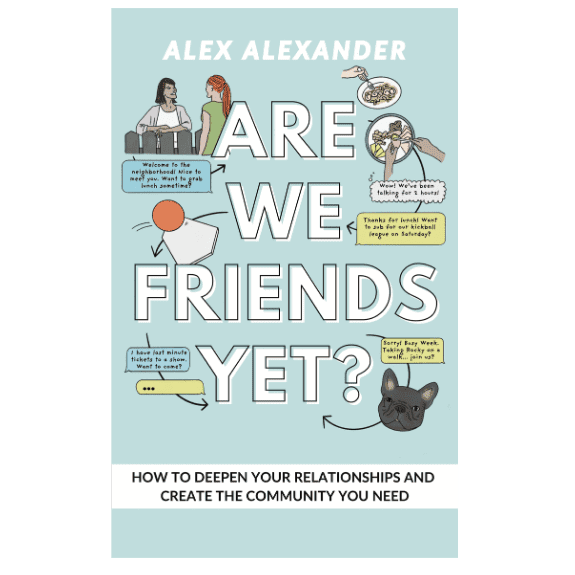
And if this episode cracked something open for you, the full roadmap lives in Are We Friends Yet? — out now. The book goes deep into exactly this: how to progress a friendship through every level, with the frameworks, the language, and the actual plan for what to do next.