You’ve heard the stat. Loneliness is as deadly as smoking 15 cigarettes a day. It gets passed around constantly in the friendship and connection space, and every time I hear it, I think the same thing: okay, but what does that ACTUALLY mean? What is happening inside the body? What is loneliness doing to the heart, the lungs, the brain?
So when I got the chance to sit down with Dr. Alan Rozanski, a cardiologist and researcher who has spent over 40 years studying exactly this, I came in with that question ready. And he answered it. Sort of. Because it turned out I was asking too small a question.
Dr. Alan Rozanski is a Professor of Medicine at the Icahn School of Medicine at Mount Sinai, where he also serves as Chief Academic Officer and Director of Nuclear Cardiology. He trained at Yale, Tufts, and Mount Sinai, founded a large preventive cardiology program at Cedars-Sinai, and has authored over 270 peer-reviewed articles. His work sits at the intersection of cardiology, health psychology, and behavioral medicine, and over four decades of research, he developed something called the Six Domains of Health and Vitality, which is the framework that completely reframed how I think about my own health.
This episode is a lot. In the best possible way.
The Question I Was Asking Was Too Small
I came into this conversation thinking about health as the absence of disease. Which, if I’m being honest, is how most of us think about it. You go to the doctor. Nothing shows up. You get a good bill of health. You’re fine.
But Dr. Rozanski asked me something that I keep coming back to: if someone isn’t depressed, does that mean they’re happy?
No. It just means they’re not depressed. Not being depressed and being happy are two entirely different things, at opposite ends of a spectrum. And the same logic applies to health. Not having disease is not the same as being healthy. The World Health Organization put this in their opening charter back in 1948: health is complete physical, mental, and social well-being, and not merely the absence of disease. They literally had to add that second clause because they already knew that’s how people thought about it.
What Dr. Rozanski has spent his career arguing is that health is better understood as VITALITY. That inner sense of feeling alive, energetic, like possibility is still open to you. He described it by pointing to his grandchildren, who don’t walk anywhere. They run. Everywhere. Full of vitality. That felt sense of being alive and energetic IS the same thing that promotes being healthy in the measurable, biological sense.
If you want to hear him unpack this in full, including the specific research that led him here and why he thinks vitality is the right north star for health, go listen to the full episode.
The Six Domains of Health
Here’s what I love about Dr. Rozanski’s framework: the body itself testifies as to what’s healthy. Anything that promotes longevity, decreases your risk of disease, and protects your physiology is healthy. That’s not a theory. That’s the standard.
And when you apply that standard across everything we know from decades of research, you get six domains:
1. Physical health. Movement, sleep, diet. The one most of us already know about.
2. Mental vitality. The quality of your thinking. Your mindsets. Optimists live longer and have less risk of heart disease than pessimists. That’s not a motivational poster. That’s 30-year-old data.
3. Emotional well-being. The spectrum from depression to happiness. When people are depressed, the body’s physiology goes haywire: higher insulin, more inflammation, the fear center of the brain actually enlarges. Depression is a major risk factor for heart disease. And happiness is protective.
4. Social connectivity. When people feel connected, supported, like they have meaningful relationships, that’s health-promoting. Loneliness is health-toxic. There are many reproducible studies showing this.
5. Purposeful living. A strong sense of life purpose is a longevity factor. Lack of purpose and boredom is the opposite. This is one of the newer areas of research, but the data is highly reproducible.
6. Stress management. Not all stress is bad. Toxic stress, the kind that’s ongoing, uncontrollable, and meaningless, is health-damaging. But the stress of pursuing something meaningful? That’s actually health-promoting. It increases your sense of optimism, meaning, and self-esteem.
What struck me as Dr. Rozanski walked through these is that they are not independent. They are a web. When one domain goes down, it pulls on the others. When one goes up, it can lift the others too. He called it a vicious cycle in one direction and a virtuous cycle in the other.
Why the Stat About Loneliness Makes More Sense Now
When I came in wanting to understand what loneliness does to the body, I was thinking about it as one isolated thing. Now I see it differently. When social connectivity is low, it drags on ALL the other domains.
Dr. Rozanski laid out roughly three pathways. First: when people are lonely, they’re less likely to pursue positive health behaviors. Exercise, diet, sleep. The sense of well-being gives you energy to do things. Take it away and health behaviors go south. Second: ongoing loneliness directly affects the body. It increases stress hormones like cortisol. It increases insulin resistance and inflammation. These compound over time. Third: social connection is a basic psychological need, the same way sleep and water are physical needs. When it’s unmet, you feel it, but not always clearly. There’s no alarm bell. You might think you need a vacation. You might think you need to go to therapy twice a week. You might not realize that what you actually need is more people around you who see you.
That last one hit me hard. I talk about loneliness as a cue all the time on this podcast, similar to a hunger cue. And Dr. Rozanski made the point that the biological needs are obvious. You get hungry, your stomach growls. But the loneliness cue isn’t obvious until you start making the connection. We’re so busy, and when we’re not busy, we’re on our phones, and we never stop to ask: why do I feel this way?
You Don’t Have to Be at Zero to Want More
Here’s where I want to slow down for a second, because I think this is the part that matters most for a lot of people listening.
When we talk about social connection being low, most people picture someone who is completely isolated. A zero. But what about a five?
What if you have friends, you love them, but they live across the country? What if you became a stay-at-home parent and none of your friends are in that same season? What if everyone in your life is great, but nobody quite fits into your actual day-to-day anymore? You have people. You still feel like something is off. And then you feel guilty for feeling that way because you have people.
That’s a five. You are allowed to be here. You are allowed to want more. And wanting more is actually the first step, so if you’re there, I’m really glad you found this episode. Friendship IRL exists for the zero and the five and the seven. It exists for anyone who wishes something was different in their friendships, community, or connections.
And here’s the thing Dr. Rozanski said that I keep coming back to: you might actually have more than you think. When I described the men who message me saying they don’t have a single friend, I always ask them: do you have coworkers you enjoy? A professional community where people know you? Family you connect with regularly? Sometimes we have more than we realize, but we have this limited definition of what counts. And when you realize you’re starting from a three instead of a zero, it feels way more possible.
The Goal Isn’t a Perfect 10 Across the Board
One of the questions I asked Dr. Rozanski was whether the goal is to get all six domains to an equal place. Like, do I need to be a 10 in everything?
His answer was no. Nobody is going to be a 10 in all of these areas. We’re all built differently. The goal is not to fix everything up to a nine or a 10. The goal is to make sure you have minimum standards in each area. You need a minimum amount of sleep. A minimum standard of diet. And you need minimum standards for social connection too. Because what he sees all the time is people completely sublimating their need for connection. Getting really involved in work, losing touch with friends, and then waking up a decade or two later and realizing those friendships just… went.
I want you to sit with that. Not as a scare tactic. As a map. If you’re putting all your energy into a domain you’re already doing well at, trying to get a nine to a ten, while leaving another domain completely untouched, that’s worth looking at. Because the six domains pull each other up or drag each other down. A virtuous cycle is available to you. You just have to find a first step.
Dr. Rozanski’s suggestion for where to start? Physical activity. Not because it’s the most important, but because it’s the gateway. When you start moving, it’s a mood elevator. It puts you on a positive track for all the other domains. Start with five minutes a day. Do it consistently. And, as I added: when you go out and move in the world, you have to go out into the world. Which means you might smile at someone. Which means connection.
One smile a day more than you do now. That was his closing thought. I loved it.
For the full conversation, including Dr. Rozanski’s specific breakdown of each domain and his answer to where to put your energy first, listen to the full episode.
What I’m Still Thinking About
I’ve been sitting with this episode since we recorded it, and the thing I keep coming back to is this: how many of us are pouring all of our energy into one domain we’re already doing well at, trying to squeeze the last bit of improvement out of it, while other domains sit at a six, quietly dragging everything else down?
I think about the hyper-focus on physical health specifically. The lifts, the supplements, the exact diet. I’ve done it. A lot of us have. And Dr. Rozanski is pointing at something different: if you’re already at a nine in physical health and you’re trying to get to a ten, while your social connection is sitting at a five and you’ve just accepted that, you might be leaving a lot of vitality on the table.
Health isn’t the absence of disease. It’s vitality. And vitality is not just physical. It’s all six of these domains working together.
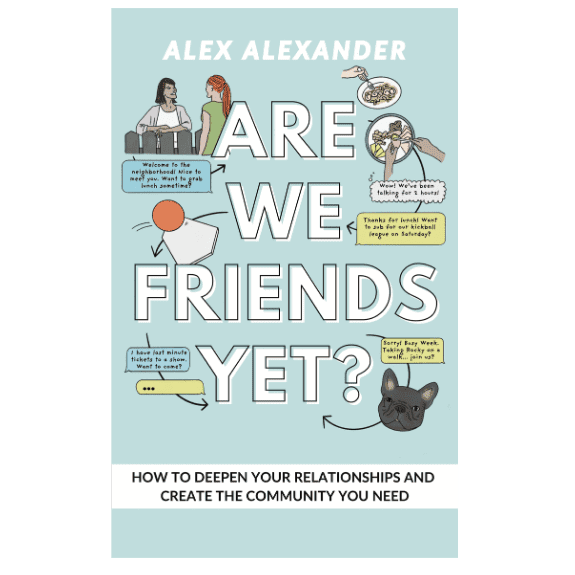
Go spend some time on Dr. Rozanski’s website. He has a blog, more podcast interviews, and a lot more depth on each of the six domains. It’s linked in the show notes. And if you’re sitting somewhere on that social connection spectrum and you want to make a shift, whether you’re at a one, a two, a five, or a seven, my book Are We Friends Yet? has guided reflection questions that will help you figure out exactly where to put your energy. That’s linked in the show notes too.
If this episode opened something up for you, go listen to the full conversation. It’s the kind of episode you’ll want to sit with.