This post may contain affiliate links, including Amazon affiliate links. If you make a purchase through these links, I may earn a small commission at no extra cost to you. I only recommend products and resources I genuinely use and believe in. Thank you for supporting Friendship IRL!
Here’s a question that’s been rattling around in my brain lately:
How do we balance community and independence?
It sounds simple. But the more I think about it, the more complicated it gets.
Because here’s the thing: We SAY we want community. We talk about how lonely we are, how disconnected we are, how we wish we had more support.
But American culture has trained us to be deeply suspicious of the very interdependence that creates community.
We’ve been taught that needing help is a weakness. Asking for support is imposing. That true strength means doing everything ourselves.
And then we wonder why we’re so exhausted and alone.
Today, I want to introduce you to someone who’s been living in this tension for 20 years. Her name is Donna Fields, and she’s an American who moved to Spain two decades ago.
Spain: a deeply collectivist culture where family ties are everything, and reciprocity is expected.
And watching Donna navigate between these two worlds has illuminated something I think we all need to see:
The ties that bind aren’t constraints. They might actually be the safety net we’ve been desperately seeking.
But accepting that safety net requires us to unlearn almost everything American culture has taught us about independence.
The Journey That Started With A Grant
Donna’s story starts in New York City, where she grew up and lived after college.
But something was missing. So she did what a lot of us dream about: She traveled around the world for a year. Hitchhiked through New Zealand, Australia, and Europe.
“I thought I really needed to mature in certain ways, and I’m not doing it by staying in New York,” she told me.
She came back to New York. Still wasn’t happy. The nightlife, the constant doing. Something was still missing.
So she moved to New Mexico. Found her people in Santa Fe. “People who just looked more deeply at issues.” Became a teacher and discovered she loved it.
After more than a decade in New Mexico, she wanted to learn Spanish. And the Spanish embassy was giving grants: free month-long programs to come learn the language.
“I thought, ‘Oh okay, I’ll go over for a month or so, learn Spanish, and go back to my school,’” she said.
That was 20 years ago.
“I’ve been here now in Spain for more than 20 years. I’m not sure why. I believe in the universe, and I try to listen to the messages the universe sends me. And for the time being, it’s telling me you’re here still, and there’s no reason to leave yet.”
So she’s stayed. And in staying, she’s had to confront everything she was taught about independence, community, and what it means to need people.
The Passport Story (Or: When American Independence Meets Spanish Community)
A few months ago, Donna did something she’d never done before in her entire life.
She got to the airport and realized she’d forgotten her passport.
For the first time ever, she’d actually left herself a couple of hours before her flight. So she had time. But not much.
And she did something that, as she told me, she could barely believe the words coming out of her mouth:
She called her neighbor.
“Could you please go up to my house, get my passport, and come to the airport and give it to me?”
The airport is an hour away. Which meant a two-hour round trip for her neighbor.
He did it. No questions asked. Nothing.
“It still gives me chills,” Donna said. “Because in the States, what we do is maybe ask and then offer to pay a lot of money for it.”
But here’s the thing that really gets me: Offering to pay would have been offensive.
Donna learned this years ago when a different neighbor drove her somewhere (just a 10-minute trip) and she offered money for gas.
The neighbor screamed at her.
“She said, ‘That is NOT how it works here. I do it because I wanted to do it.’”
In Spanish culture, helping isn’t a transaction. It’s an expectation. It’s what community means.
And for Donna, after 20 years of living there, that passport moment was a turning point.
“I realized that I had to open up. I had to make a huge shift. Because what that meant here is that I need to be available whenever he needs me.”
She paused. “And I thought: You know what? I can do that.”
But it took her 20 years to get there.
In the full article, we’ll explore why it took so long, what she had to unlearn, and what this reveals about American individualism that most of us have never questioned.
What Spain Showed Her About American Culture
One of the most striking things Donna said to me was about identity.
“In New York especially, and in the United States in general, we believe that working is the most important thing. We identify ourselves through our jobs.”
In Spain? People identify themselves by what they do AFTER work.
What they do after they clock out. How do they spend time with family? The life they build outside of productivity.
“My neighbor, for instance, he’s in his 40s, so intelligent, incredibly intelligent and talented. But he was bored to death in school. He could leave at 15, so he left and started working. Now has no certification.”
In Spain, you can’t do anything without certification. So Donna felt it was her job to find him a better job. To help him get more money and more prestige.
“I was doing this for the first two years I lived here. Kept saying no. He said, ‘No, I’m not interested.’”
She laughed. “Just recently, his new job offered German lessons so they could send employees to Germany. And I said, ‘Oh my God, that’s perfect!’ I’m still doing it to him.”
But here’s what she’s realized: “They are satisfied with what they have, and they make the most of it.”
They come home and do things with their family. Not watching TV. Actually DOING things. Being together.
“For me, that’s still a challenge,” Donna admitted. “It’s still a challenge.”
Because American culture has taught us that satisfaction without constant striving is… settling. Giving up. Not reaching your potential.
But what if it’s actually just… living?
The Hyper-Vigilance of Independence
As Donna discussed Spanish culture versus American culture, something clicked for me.
When we live in this hyper-individual situation, we’re constantly living in a state of hyper-vigilance. Because we can never mess up.
Think about Donna’s passport situation. If she hadn’t called her neighbor, she would have missed her flight. Completely. No options.
So you can never make that mistake. Which means before you leave the house, you have to panic and double-check that you have your passport 12 times.
The stakes are always high when you have no safety net.
Let me give you a personal example: We went out of town for a wedding recently. I realized I’d forgotten to stop our mail.
Not a huge deal, except I got a notification that a package had been delivered: new tennis shoes I’d ordered. $100 tennis shoes, sitting on our front porch on a busy street where anyone walking by could see them.
We’ve never had a package stolen. But I panicked. I should have remembered to do that small task. I messed up. And now, because of it, somebody might take the shoes.
I was going to worry about it all weekend.
And then I thought: You know what? I have the phone numbers for the ladies who live on either side of us. I’ll just text them.
A 30-second ask. “Hey, could you grab that package off our porch and throw it in your house?”
They did. The shoes were fine.
But here’s what that made me realize: When we have to do everything ourselves, we can’t forget ANYTHING.
If you forget anything, there’s a repercussion. And we’re managing this level of vigilance how many times a day?
Here’s another example: Let’s say you have a five-year-old who’s coming home on the bus. And you get caught in traffic (not even your fault) and you’re going to be five minutes late.
The amount of anxiety you would have about that five-year-old walking up to a locked door with no one home…
They probably don’t have a way to contact you. You don’t know any neighbors well enough to call. You’re just… panicking for those five minutes.
But what if you knew a few neighbors? Someone who works from home. An elderly person who’s retired. A family with a teenage kid who gets off their bus 15 minutes before yours.
One quick phone call changes everything. Those five minutes aren’t as consequential.
But when you don’t have that? It affects EVERYTHING. And we’re doing this all day, every day, feeling like we can never mess up.
The Small Town vs. Big City Question (And The Loneliness Stats)
Donna asked me an important question: “Is this a societal generalization, or does it also have to do with how you’re raised? Is it better in small towns?”
Honestly? I don’t have the small town vs. city stats in front of me.
But I do know this: 60% of people in the United States believe they don’t have a single person who truly knows them.
Sixty percent.
Think about that for a second. More than half of us feel completely unknown.
And the loneliness epidemic, the sense that we have no one to depend on or call? It’s pretty dire. The stats are released everywhere.
This loneliness is attributed to so many huge societal issues. Health problems. Mental health crises. Political division.
And at the root of it? Our inability to ask for help. Our belief is that needing people makes us weak.
What We Lost (And When We Lost It)
There’s a book I reference a lot called “Bowling Alone” by Robert Putnam. It was written in 2000, so take some of the stats with a grain of salt. But the core observation is crucial.
Americans are spending less and less time involved in social groups.
Not friend groups: I mean clubs, societies, organizations. Rotary. Community groups. Civic organizations. Local government. Churches.
As this decline happened, we stopped identifying with these groups. Previous generations would join these groups, and they’d become part of your identity. A second family. A way you identified yourself.
But now? We see ourselves as individual blocks who can come and go as we please.
And because of that, these smaller groups have become merely an occasion for us to show up and focus on ourselves in the presence of others.
We don’t show up to GIVE to the group. We show up because we want to work on a certain skill, support a certain cause, or feel a certain way.
It’s about what I want and how I want to feel, not about the group as a building block of society.
Before, you’d show up to the group, become PART of the group. They could call on you. You could call on them.
Now? We’re individuals who happen to be in the same room, working on our individual goals.
The purpose of the group isn’t the group. The purpose is for me as an individual to feel a certain way.
And when you really think about it… That’s kind of mind-boggling.
Donna’s 20-Year Journey to Accepting Help
So, back to Donna and that passport moment.
I asked her: How long did it take you to start tapping into that community aspect?
Her answer? “Yesterday.”
We both laughed. But she was only half-joking.
“It wasn’t until I moved here. A month later, my little neighbor’s father said, ‘I’m going to help you redo your house.’”
Donna was going to hire people. That’s what Americans do. We hire people, pay them, and when we come home, the work is done.
The workers didn’t show up. And her neighbor said, “I am going to help you have the house of your dreams.”
“I thought, ‘What? WHAT?” Donna said. “And he did. He worked with me for two years, redoing my entire house.”
She was nervous pretty much the whole time. About a year and a half in, she started realizing there were things she could do for him.
“But being an American, I was very, very conscious of the fact that I needed to do something for him. He did not expect it.”
Little by little, over 22 years, she’s learned. But she’s clear: “I am highly individual. Maybe someone else would not have taken so long.”
She didn’t come to Spain to make a family. “I really was not emotionally ready. I needed to get rid of a lot of dark clouds in my life before I could add value to someone else’s life.”
“It’s a mutual agreement. You can’t just expect something from them. You also need to give back. And until you’re ready to do that, don’t dive in.”
Nourishing vs. Reciprocity
As Donna was talking about giving back, I realized we needed to reframe something.
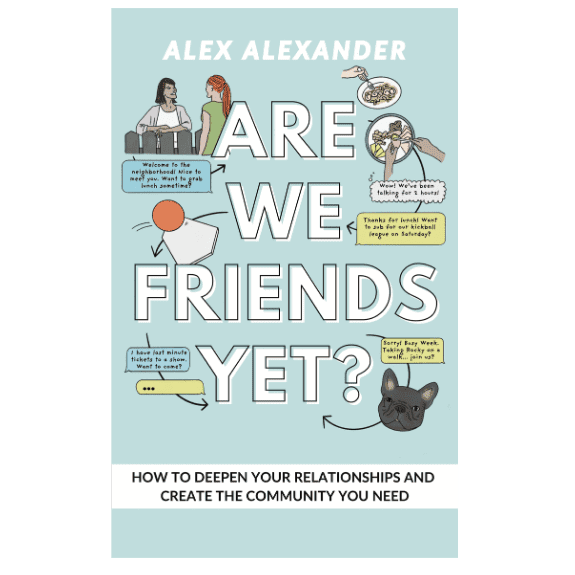
In my book, I talk about how I don’t actually like the term “reciprocity”, at least not how it’s used in the US.
In America, reciprocity has become: “I gave you a cookie, so you owe me a cookie.”
It’s tit-for-tat. Equal exchange. Transactional.
Instead, I talk about nourishing your community.
That word shift allows you to think about what YOU have to give. What skills are easy for you? What ways are easy for you to show up that somebody else might really need?
And it can look different.
Donna’s neighbor helped her redo her house for two years. She helps his family with things like printing documents (they don’t have a printer) or buying plane tickets online (she knows how to navigate the websites).
It’s not the same thing. It’s not the same monetary value. It’s not the same exchange of time.
But it’s what they each need. And they can both show up in ways that feel right.
That’s nourishing the greater good.
Similarly, maybe you’re helping one friend, and that friend’s friend is the one who really benefits from what you offered. It’s trusting that this greater web of people has what you need somewhere out there.
And I use the word “trusting” very intentionally.
Because you have to trust that what you can offer is valuable. And you have to trust that when you need something, someone will show up with it.
That’s a lot of trust. Especially when you’ve been trained your whole life not to need anyone.
In the full episode, Donna and I go much deeper into what she actually observed living in Spain and how those 20 years shifted the way she sees community, reciprocity, and what it means to really need people. If you’ve ever felt like American culture makes it hard to ask for help, this conversation will name exactly why.
The Small Actions That Create Ripples
Near the end of our conversation, Donna said something that really stuck with me.
She listens to a lot of podcasts about near-death experiences. And one thing people consistently say: It’s the little things that matter.
The little niceties. Saying hello to someone on the street, even if they don’t say hello back.
“There are a lot of older people. Nobody might have said hello to them the whole day,” Donna said. “For me, it’s such a little thing. Just ‘good morning, good afternoon.’ Their faces light up.”
And maybe they’ll do something nice for someone else later. Or maybe they won’t. It doesn’t matter. You did your job that day.
I do this all the time at the grocery store. I ask the checkout person how they’re doing. Really ask.
People are so caught off guard. “Oh! Thanks for asking.”
Because maybe they’ve had 100 interactions that day and nobody has paid them any attention.
That stuff matters. It adds up.
And here’s what science shows us (I talk about this in Episode 41 about the “liking gap”): Our brains play tricks on us.
We assume these small interactions aren’t meaningful to other people. We think people don’t enjoy them.
But that’s not true. Studies show people DO enjoy these simple interactions.
We’re just convinced they don’t, so we don’t engage in them.
Donna mentioned something her neighbor specifically told her: “I’m not doing this for any other reason than I want to.”
And what’s satisfying for him isn’t that Donna helps his family directly; it’s that she helps the neighbors when they need help.
Someone needs something printed. Donna prints it. Someone needs help buying a plane ticket online. Donna spends hours helping.
They fix her car so she doesn’t have to go to the shop.
“It’s the trust issue,” Donna said. “I want to help you with your car because I know when I need something, you’ll use your skills for me.”
Why The Printing Matters More Than You Think
Let me pause on that printing example for a second. Because I think it illustrates something crucial.
To Donna, printing something seems like such a small task. She already has the printer and the computer. Two seconds, done.
But for them, if they didn’t have that?
They’d have to get on public transportation or drive somewhere. Find a place to print. Log in on an unfamiliar machine. Hope it works. Pay for it.
It’s not even the cost: it’s the HASSLE.
Versus: Walk next door. Ask Donna. Done.
We don’t even know the value of the ways we can show up.
And that’s actually the hope: that the easiest things for us to give are what others need most. Because then we’ll WANT to keep giving.
My personal example: I love to cook. I’ll cook for my close friends. I’ll cook for my friends’ friends if I have the capacity.
Because I actually love cooking. It’s how I relax. It’s enjoyable to me.
Sometimes I want to cook, and we don’t need more baked goods or freezer meals. So, when someone else needs food? You’re giving me the opportunity to do something I love for someone who actually needs it.
But if you don’t like cooking or don’t have the capacity, that seems like such a HUGE thing I’m giving. The time! The effort!
To me, it feels like a blink of an eye because I love it.
So if we can tap into what’s actually easy for us to give, we’ll keep doing it. And the whole system works.
What We Can Actually Do (Without Moving to Spain)
So here’s the question: What can we do in the States to let down our guard a little bit?
Even if society celebrates individualism, what can we do to become more communal?
My answer: We need to decide to ignore the way it “should be.”
We need to acknowledge that these norms aren’t serving us and choose to act differently.
Go meet your neighbors. Offer to do little things. Take out their trash. Grab their mail if something’s wrong. Check in on people.
Start talking with people about the fact that we NEED this.
And you can even name it explicitly. Instead of just saying “Here’s my number in case anything comes up,” say:
“Hey, the next time you’re worried because you forgot to do something, just know I’m always happy to help out with those small tasks if you’re in a situation.”
Explain WHY you’re doing it.
Because I think if more people start ignoring the way it should be and doing these little things, over time, that’s going to add up.
You might do that for one neighbor. That neighbor might realize they don’t really know anyone else on the block. So they go meet a few more people.
Suddenly, we have a bunch more connections than we had before.
It’s the little things that add up.
Not grand gestures. Not a perfect community. Just small, consistent actions that say: “I see you. I’m here. We’re in this together.”
The Trust You Have To Build
But here’s what Donna made really clear: This requires trust that most Americans have never learned.
We’ve been taught to only trust ourselves. Maybe a select few others.
So, choosing to act differently? It’s a lot of work.
You’re going against the grain. You’re trusting in a way you haven’t been taught to trust.
And I want to be honest about this: Both options are hard.
It’s hard to change the way we’re acting, even in small ways.
It’s also hard to continue living with that hyper-vigilance of never being able to mess up.
They’re both hard. Neither is better. We’re just more used to one version of hard.
So you get to choose. But choose consciously.
What Donna Learned About Herself
Near the end of our conversation, I asked Donna what she’s learned about herself through this 20-year journey.
“It’s really important to know ourselves,” she said. “And it’s really important to be generous about how other people are acting.”
She was brought up by someone very judgmental. So she learned judgment.
“But I realized that people are doing the best they can. And I know that’s very cliche. And yet, I realized everybody’s best is a little different.”
“It’s really important not to react to people. But to just remember that we’re here to share energy.”
She paused. “Everything we do has ripples, either negative or positive. Everything has ripples.”
“We may not know 99% of the effect we have on the universe. And yet, I think it’s really important to realize that we do have an effect.”
Someone sent her a quote recently: “Believe that everything you do matters, because it does.”
“I know that,” she said. “And yet it’s so powerful reading it.”
“Anytime we can remember that we’re all doing the best we can, we will send those ripples out. Smooth ripples.”
She laughed. “I know this sounds so easy. But this is what I wake up thinking: I’m going to try to do this even better today.”
The Question We Started With
So let’s come back to where we began: How do we balance community and independence?
I don’t know if we answered that question. Honestly, I think I’m more confused than when we started.
But maybe that’s the point.
Maybe the question itself is flawed. Maybe it’s not about BALANCE, like we can have perfect amounts of each.
Maybe it’s about recognizing that American individualism has swung so far in one direction that we’ve lost something essential.
We’ve lost the safety net. We’ve lost the ease. We’ve lost trust.
And getting it back doesn’t mean giving up all independence. It doesn’t mean moving to Spain and spending 20 years learning to accept help.
It means making small choices every day to act like we’re part of something bigger than ourselves.
It means saying hello to strangers. Asking checkout people how they’re doing. Offering to help neighbors with small tasks. Accepting help when it’s offered.
It means commenting thoughtfully on social media instead of just scrolling. Showing up to community groups and actually giving to them, not just taking.
It means trusting that the web of people around us has what we need, and that what we have to offer is valuable.
Even if it’s just printing a document. Even if it’s just grabbing a package off a porch. Even if it’s just saying “good morning” to someone who needed to be seen.
The Permission You Need
If you take nothing else from this article, hear this:
You are allowed to need people. You are allowed to ask for help. You are allowed to be part of something bigger than yourself.
American culture has told you that independence is strength and needing people is weakness.
But what if that’s backwards?
What if true strength is having the courage to be interdependent? To trust? To give and receive in ways that don’t look like equal transactions?
What if the ties that bind aren’t constraints, but the very thing that sets us free from the exhausting hyper-vigilance of doing everything alone?
You get to choose your hard.
You can keep living with the anxiety of never being able to mess up. Or you can do the work of building trust and community.
Both are hard. But only one leads to connection.
Only one leads to that moment where you forget your passport, and someone drives two hours round trip to bring it to you, not because you’re paying them, but because that’s what community means.
And maybe, after 20 years like Donna, or maybe sooner, you’ll realize: You can do that too.
You can be available when people need you. You can trust that your small offerings matter. You can accept help without shame.
You can choose community. Even in a culture that’s taught you not to.
It starts with one small action. One hello. One offer to help. One moment of letting someone in.
What will yours be?
In the full episode, Donna shares more about the small, specific things she does to nourish her community and how those actions have built the kind of trust that shows up when it really matters. If you’re wondering how to start building that kind of connection without overhauling your entire life, this is worth a listen.
Want to explore this topic further? Donna has put together some materials about cultural differences and how they affect community formation on her website.
What’s one small way you can act like you’re part of something bigger this week?