If you have ever walked into a room full of people and felt instantly like the kid who doesn’t belong, you are not imagining it. That feeling has a history. And for a lot of us, that history starts in a middle school hallway.
I get messages all the time from adults who say some version of the same thing: “I was always the one who got left out. I was bullied. I had friends, but I never really felt like I connected with anyone.” And what strikes me every time is how present-tense those messages feel. Not “I used to feel that way.” Just: this is who I am.
That is the conversation I wanted to have in Episode 193. My guest is Coach Sheri Gazitt, founder of Teen Wise, and she has spent 30 years working with girls on exactly this: the friendship skills that get built or not built in the teen years, and how those patterns follow us into adulthood. She has a master’s in counseling psychology from Rice University, she works with over 20,000 moms every month, and she gets excited when parents call her with a problem because she can see the skill gap underneath it.
This episode is for two audiences. If you are a parent trying to figure out how to help your daughter through friendship drama right now, this one is for you. And if you are an adult who is still carrying around beliefs from your own teen years, this one is also for you.
Listen to the full episode at friendshipirl.com/episode193
What “Girl Drama” Actually Is
Here is what Sheri said that reframed everything for me: girl drama is not about mean girls. It is about girls who have not yet learned the skills of healthy connection, and who are doing their best with the tools they have.
When a girl excludes someone, or starts a rumor, or suddenly drops a friend, there is usually a thought underneath it. Something like: “I might lose my best friend because this new girl is around now.” Or: “Nobody talked to me at lunch today, which must mean nobody likes me.” The behavior comes from the fear. And the fear comes from not having the skills to navigate the situation differently.
That reframe changes what we do about it. A skill gap, you teach.
This also applies to the girls who are on the receiving end AND the girls who are doing the excluding. Sheri works with both, and her approach is the same: what does she need to learn? What is she struggling with? What are the limiting beliefs underneath the behavior?
The Four Pillars Teens Actually Need
Sheri has spent years figuring out what actually helps girls who are lonely or stuck in drama cycles. She landed on four areas that all need attention:
Identity
Girls need a basic sense of who they are, even as that shifts week to week. The goal is not a fixed identity, it is the ability to accept themselves as they change.
Beliefs
What is going into the backpack? After a friendship ends badly, does a girl walk away thinking “friendships always end” or “nobody likes me once they really know me”? Those beliefs compound. The work is not eliminating negative thoughts. It is learning to recognize them, and then being able to see other possibilities alongside them.
Emotional resilience
If we want girls to put themselves out there, they have to be ready for the fact that not every connection will click. Sheri compared it to dating: you have to get comfortable with rejection as part of the process, not evidence that something is wrong with you.
Interpersonal skills
This is the one that often shows up as social anxiety or withdrawal. Some girls do not know how to start a conversation with someone new. Some do not know how to enter a group. Some do not know how to repair a friendship after a conflict. These are learnable skills, and the specific gap varies by person.
What I keep coming back to is that last one. So many people who message me have sent these long, detailed emails about a friendship situation, and I can see in about two paragraphs that there is one specific skill they are missing. One thing. And they have been carrying around “I am just bad at friendship” for years because nobody named the actual gap.
If this is landing for you, the full episode goes deep on each of these pillars and what they look like in practice. Listen at friendshipirl.com/episode193.
The Limiting Beliefs Parents Pass Down Without Knowing It
This is the part of the conversation that a lot of parents need to sit with.
Sheri pointed out that parents often try to help by minimizing. “Girls are just mean.” “You won’t even remember these friends in ten years.” “Just find new people in college.” These feel like comfort, but what they actually do is hand a girl a filter through which she sees all future friendships.
If girls are just mean, what does that say about your daughter? What does it say about you?
There are three patterns Sheri sees in how parents respond to friendship drama.
- ▪️ Dismissive: minimizing so the kid does not feel so bad.
- ▪️ Dramatic: getting so emotionally activated that the parent’s feelings flood the room.
- ▪️ Intrusive: trying to fix everything, orchestrating conversations, solving the problem for the kid instead of with her.
All three come from love. None of them teach the skill.
What actually helps is something Sheri calls the LOVE framework:
- ▪️ Listen first without peppering them with questions.
- ▪️ Offer advice only after asking if they want it.
- ▪️ Validate the feeling, even if the behavior was not okay.
- ▪️ Help her work through it by asking questions alongside her, not handing her the answer.
And then, critically: remember that she may not be able to execute the plan you worked out together. Because the skill is still being built. If your daughter goes into that conversation and freezes, or says the wrong thing, or doubles down instead of apologizing, that is not failure. That is practice.
The Floater Friend Problem
One thing Sheri said that I keep thinking about: some girls stay silent in groups because they are so in their heads about what to say and how to say it. When you never talk in a group, you become the floater. The one who is always around but never quite included. The one who gets left off the invite list not out of malice, but because nobody feels close enough to think of her first.
The answer here is building the skill of one-on-one connection within a larger group. You cannot get close to someone in a group of fifteen. You have to find the person and reach out outside of that context.
I talk about this in terms of the Wheel of Connection framework. A lot of parents have told me that this one framework changed how they understand their kid’s friendships. Once you have language for the different types of relationships in your life, and in your kid’s life, you stop treating every friendship like it carries the same weight and expectations. A defined friend, someone you are close with in one specific context, does not require the same energy as a present friend. And that clarity alone takes an enormous amount of pressure off.
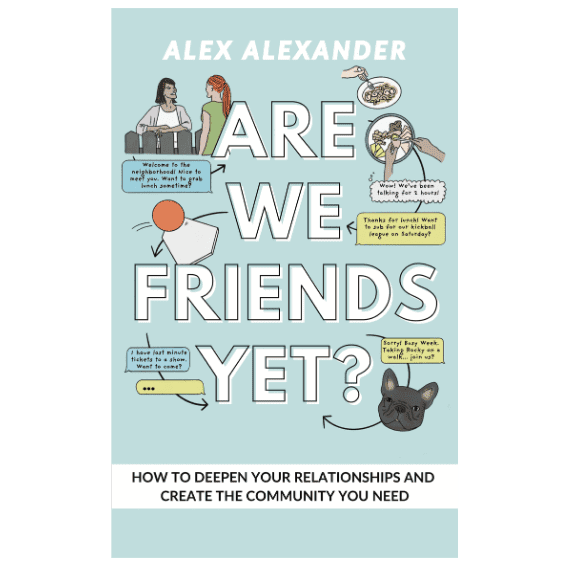
If you want the full breakdown of the Wheel of Connection, go to Episode 100, or grab a copy of my book, or check the show notes for the free downloadable guide.
How Teen Patterns Show Up in Adult Friendships
Sheri said: the patterns you built as a teenager are largely subconscious. You do not decide to walk into a room expecting people not to like you. You just do it. You end up on your phone in the corner, or sitting away from everyone, and then nobody talks to you, which confirms the belief, which makes you do it again next time.
That is not a personality trait. That is a pattern. And patterns can change.
We talked about people-pleasing as one of the most common ones that carries from teen years into adult friendships. The girl who made herself so accommodating, so easy, so useful, that she never actually let anyone see her. Those friendships stay shallow not because the people pleaser is doing anything wrong, but because depth requires showing up as a real person with real opinions, and she never learned it was safe to do that.
I shared my own version of this. I spent years believing that in order for someone to want to be my friend, I had to be useful to them. I was the one cooking dinner for 35 people at the last minute, arranging everything, making myself indispensable. I still show up for my friends, but I do it now from a different place. Not from “I have to do this so they keep me,” but from actual choice.
If you are somewhere in that pattern right now, the full episode is worth your time. Listen to Episode 193 for the full conversation about how these patterns form and what it actually takes to shift them.
What to Do Tonight If Your Daughter Is in a Friendship Crisis
Sheri’s answer to this question was not what I expected. She did not say call a therapist or have a big talk. She said: start with yourself.
Go back to your own teen years. Journal about it. Think about what you learned from your friendships then. What limiting beliefs did you carry forward? What filter are you looking through when your daughter comes home in tears?
Because the way you show up in those moments, whether you dismiss or dramatize or intrude, is shaped by your own history. And if you can see that history clearly, you can show up differently.
Her other resource for parents is the Mom Wise Collective, a coaching community she runs through Teen Wise specifically for moms who are navigating this alongside their daughters. The link is in the show notes.
And if you are an adult reading this who did not have a parent who could do any of this for you, this episode might be a place to start re-parenting yourself. The skills are learnable at any age. You can build them now.
Listen to the full episode.