Let me tell you about Wesley Stroup.
He’s a socially anxious gay man living in a small town in North Carolina. He describes himself as “incredibly, intensely socially anxious.” He moved back after the pandemic, landed in a tiny town without a major metro nearby, and found himself isolated in a way he hadn’t experienced since childhood.
And then he decided: Something has to change.
So he joined a Unitarian Universalist church. He got on Bumble BFF specifically to make male friendships. And he started hanging out in VRChat (yes, virtual reality), where he now has a regular crew of friends he meets on Friday and Saturday nights.
None of this looks like the picture-perfect friendships you see on Instagram. And all of it is working.
When Wesley reached out to me via voice memo (yes, people actually use that feature on my website!), I knew immediately I wanted to have this conversation. Because here’s someone who’s actively trying multiple unconventional approaches to friendship, not because they’re trendy or Instagrammable, but because he decided connection matters enough to get uncomfortable.
And I think that’s exactly the kind of story we need to hear more of.
When Your Safety Isn’t Guaranteed
Before we dive into the methods Wesley’s using, I need you to understand his starting point.
“I’m a gay dude in a small town,” he told me. “That changes the trajectory of all of it.”
He went to the Unitarian Universalist church initially because of the trans rights legislation that was ramping up in his state. “Not me, but I’m next,” he explained. “I need to find the people who are okay to be myself around and be open.”
Let that sink in for a moment.
While some of us are worried about whether we’ll click with potential friends or if the conversation will be awkward, Wesley is navigating an additional layer: Will I be safe? Will I be accepted? Will someone harm me?
“I had to rebuild,” he said. “And I was pretty isolated in a way that I don’t miss from being a kid.”
When he talks about making male friendships specifically, that fear becomes even more acute: “Are they going to get mad at me? Are they going to reject me? Are they going to harm me physically?”
He’s quick to add: “Those things aren’t actually all that common in my actual experience. But you get told these things, you see these things.”
Reality is sometimes different from what gets built in your brain.
And yet, despite the fear, despite the isolation, despite living in a place where he has to actively seek out safe spaces, Wesley is out there doing the work.
If that’s not inspiration, I don’t know what is.
Method #1: The Unitarian Universalist Church (Or: Finding Your Formal Community)
Wesley grew up as a pastor’s kid. Not in a Unitarian Universalist church, but he was deeply connected to the organizational and communal aspects of church life.
“I love a potluck,” he told me, laughing. “I can’t go anywhere else to find a potluck.”
But it’s more than just the food. It’s the intergenerational connections. The ritual. The structure. The sense of belonging to something larger than yourself.
“When I was a kid, I would do handbells with my grandmother,” he shared. “There’d be older folks there. You could know families, you could know people who could be your grandpa. Full sense of community.”
So when he moved to his small town and saw there was a Unitarian Universalist congregation, he knew that could be a place where he might feel safe. Where he could be himself.
And here’s what I love: He didn’t just show up and sit in the back.
He got involved. Now he runs the Zoom every Sunday, managing the technical side so that people stuck at home, older folks in assisted living, and those who can’t physically get to the service can still participate.
“It’s social plus awkward sound board guide in the back,” he described it. “It’s really nice.”
He’s also been on committees (though he just got off one and feels “so free” (his words, and honestly, relatable). He stays for coffee hour. He talks to people about D&D. He’s building relationships with people of all ages.
“There’s a mix of the familial and the friendly and the casual and the ‘oh, I’m glad that this person is in my community and I know them,’” Wesley explained. “There’s the whole gamut there.”
Has he made super close friends there? Not quite yet. But he’s met people he’d connect with outside of Sunday services. People he asks about. People who ask about him.
And most importantly: He’s found a place where he feels like he belongs.
In the full episode, Wesley and I talk much more about what it’s like to find formal community as an adult, especially when you’re looking for safe spaces. We also dive into my Wheel of Connection framework and why formal community is such a crucial piece of building a full, rich social life. If you’ve been struggling to find “your people” or wondering where to even start, this conversation will give you some real, practical ideas.
Why Formal Community Matters (Even If It Feels Old-Fashioned)
Okay, quick detour because I need to talk about this.
When Wesley described the church, I got SO excited because this is exactly what I mean when I talk about formal community in my Wheel of Connection framework.
Formal community is a place you go to or a group you participate in where people come together around a common goal or interest.
It usually has some structure: maybe a leadership team, scheduled meetings, rules or regulations. And because it’s centered around a common interest with built-in structure, it’s actually a GREAT way to meet new people.
But here’s what nobody tells you: Showing up to these groups feels awkward as hell at first.
Everyone else seems to know what’s going on. They know each other. They know where the forks are for the potluck. You feel like the new kid at school.
But if you keep showing up? Eventually, you start to believe “I belong here.” And that belief is incredibly powerful.
For Wesley, the church provides:
- ▪️ Regular, recurring interaction (every Sunday)
- ▪️ Intergenerational connections
- ▪️ A role to play (running the Zoom)
- ▪️ A sense of safety and acceptance
- ▪️ Familiar faces
That last one (familiar faces) becomes a huge theme in Wesley’s story. But we’ll come back to that.
Method #2: Bumble BFF (Or: The Intentional Pursuit of Male Friendship)
Here’s something Wesley said that stopped me in my tracks:
“I think men need more friendships in general. I think men need more male friendships. And men need more friendships with people of various genders, ages, and backgrounds. But friendship with men… It’s scary.”
He went on: “In school, in work, in whatever, I easily would become friends with women. That was easy, natural, didn’t worry about it. But making friends with men? It didn’t happen casually.”
So he got on Bumble BFF specifically to make male friendships.
And before you roll your eyes at friendship apps, hear me out. Because Wesley’s experience with Bumble BFF is actually fascinating.
He made one of his closest friends in the world on Bumble BFF.
They met a couple of years ago. His friend got into med school and is almost done now. Wesley’s been able to watch that journey, support him through it, and go to shows together.
But it’s not just that one friendship. Through that friend, Wesley met roommates. Got invited to a New Year’s thing. Now has a group of people spread across the East Coast.
“It’s organic, but it happens,” he explained.
Here’s what I think is important about Wesley’s Bumble BFF experience: He’s not treating it like it’s going to magically produce perfect friendships overnight.
He engages with it “as earnestly as possible.” He puts in the work. He has actual conversations. He meets up with people. And sometimes those connections lead to other connections, which lead to finding his people.
“I think if you engage with almost any platform earnestly, it’ll do something,” Wesley told me. “Engage with any community. If you put yourself there and you’re like, ‘I’m doing this for real,’ most of it will work if there are other people.”
The full episode includes more about Wesley’s Bumble BFF strategy and how he thinks about making male friendships as a gay man. We also talk about the difference between trying to “skip” to friendship versus doing the actual work of getting to know people. If you’ve been on the fence about trying friendship apps, this conversation might change your mind.
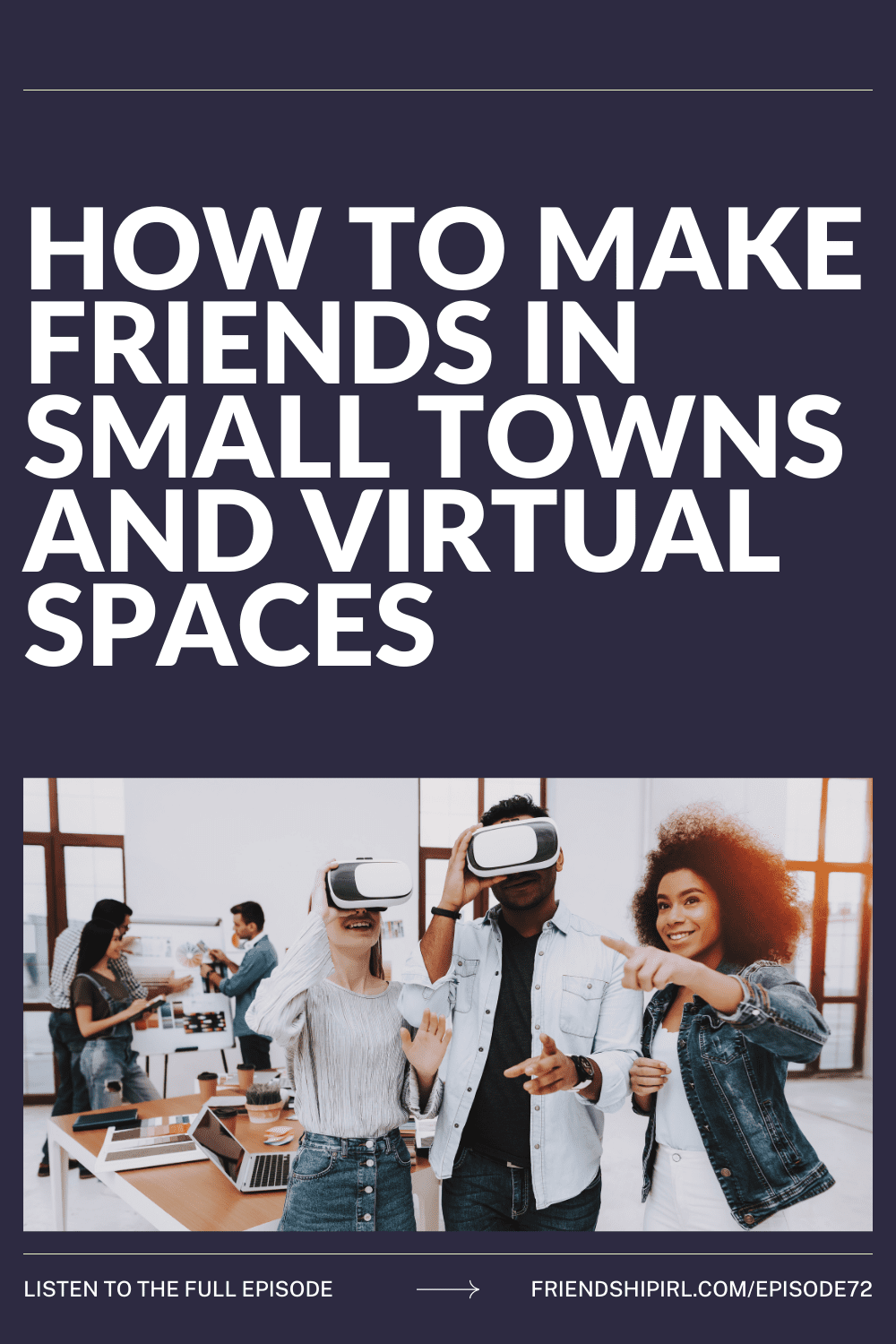
Method #3: VR Chat (Or: When the Virtual World Feels More Real Than Your Town)
Okay, this is where things get really interesting.
Wesley has had a VR headset since 2017. He’s tried various virtual reality platforms over the years. But VR Chat? That’s where he’s actually built real friendships.
And I’m going to be honest with you: I had NO idea what to ask him about this. I’ve never tried VR. I don’t know how it works. So this conversation was me fumbling through questions while Wesley patiently explained this whole world I knew nothing about.
Here’s what I learned:
VR Chat is a virtual space where you can be literally anything. An anime character. A furry. A Roomba with a Kmart logo that plays Kmart commercials. (Yes, that’s a real avatar Wesley has saved.)
There are “worlds” you can go to: different rooms or spaces. Some are public, some are private. You can play pool (billiards is huge in VR Chat, apparently). You can do trivia. Play card games. Go to open mic nights where people tell jokes and sing.
“It feels like getting ready to either go to the bar or go to an open mic night or go hang out at the mall,” Wesley explained. “Getting the headset on, getting your little fruity beverage together, and setting that where you’ll get the straw in without spilling all over yourself.”
It’s as real a thing as going out in physical space. It’s just a different version of the world.
Wesley mostly hangs out with a regular crew of friends he’s made in VR. Friday and Saturday nights, they meet up, sometimes in public spaces, sometimes in more private gatherings that feel “closer to a dinner party.”
“I am a night owl,” he told me. “So I think I’ve basically just made a bunch of Midwesterner friends.”
Because here’s the thing about VR: Time zones flatten. Geography doesn’t matter. If you’re in a small town where the bars close early and there aren’t many third spaces, VR gives you access to social spaces that are always open.
And before you dismiss this as “not real” friendship, consider this: Wesley sees familiar faces. He has inside jokes with these people. He checks in on friends at the Sunday open mic. He’s built actual relationships.
“People are the same everywhere,” he said. “That’s awesome.”
But… Is VR Friendship “Real”?
I know what some of you are thinking. Virtual reality friendships? Really?
Here’s what I want you to consider:
Wesley is building connections with real humans. They’re having real conversations. They’re showing up for each other consistently. They’re creating shared experiences and memories.
The only difference is the medium.
We don’t question whether phone friendships are “real.” We don’t dismiss long-distance friendships that exist primarily through video calls and voice memos.
So why would we dismiss friendships that happen to take place in a virtual space where you’re represented by an avatar?
Especially for someone like Wesley (living in a small town, navigating safety concerns, dealing with social anxiety), VR provides access to community he simply doesn’t have in his physical location.
“It feels like a small to midsize city with just a bunch of different groups of people,” he described it.
And honestly? After talking with Wesley, I’m genuinely curious to try it myself. (Wes, if you’re reading this: let’s meet up in VR! I need to experience this firsthand.)
In the full episode, we go much deeper into what VR Chat actually looks like, how Wesley navigates it, and what kinds of interactions happen there. We also discuss the need for more inclusive spaces in VR (such as sober spaces) and how virtual worlds are creating new possibilities for connection. If you’ve ever been curious about VR friendships or dismissed them as “not real,” this conversation will challenge your assumptions.
The Thread That Connects Everything
Halfway through our conversation, Wesley said something that made everything click into place:
“My through line on church, on Threads, on VR Chat, on Bumble BFF… the familiar faces thing is the thing that we could really build into our technology better than we have previously.”
Familiar faces.
That’s what he’s seeking in every single one of these spaces. Not immediate best friends. Not perfect connections. Just… familiar faces. People he sees repeatedly. People he can slowly get to know over time.
At church, he sees the same people every Sunday. On Bumble BFF, he’s building relationships with people he can keep showing up for. In VR Chat, he has his regular crew. Even on Threads (Instagram’s text-based platform), he’s found a community of people he interacts with regularly.
“It’s the repetition that allows us to slowly, over time, start to get to know someone, build up some memories and connection points and shared experiences,” I told him. “That is where we get to that point where we consider someone our friend.”
And Wesley is actively, intentionally putting himself in spaces where that repetition can happen.
That’s the work. That’s what it takes.
When Your Tank Is Empty But You Show Up Anyway
I asked Wesley something I knew people would want to know: What happens when you can’t show up? When your plate is full, and you’ve got nothing left to give?
His answer was beautifully honest:
“There are times when I know that I’m overwhelmed with life. And when someone has asked me to come and I’m like, ‘Oh, I just really don’t feel like it.’ I take a moment and sit back.”
Sometimes, he honors where he is and says, “I’m gonna have to catch you all next time, because I’m exhausted.”
But other times, he pushes himself: “This is important to them. I’m willing to sacrifice a little bit of time and energy. Maybe I won’t stay the entire time, but I’m going to at least show up.”
And here’s what he’s learned: “Those are usually the times I end up staying longer than I anticipate. Because I’m like, ‘Oh, I got caught up. And maybe this is actually what I needed.’”
Sometimes we don’t need to shut ourselves away at home. Sometimes what we actually need is to be around people, even when (especially when) our tank feels empty.
This doesn’t mean forcing yourself to socialize when you’re truly depleted. But it does mean questioning that voice in your head that says “stay home” every single time.
Maybe what you need is to show up in your sweatpants. To order takeout to your friend’s house because what they planned for dinner doesn’t sound appealing. To leave early if you need to.
The key is having friends who accept you exactly as you are in that moment.
The Methods That Work Aren’t Always The Ones That Look Good
Here’s what I love about Wesley’s approach: He’s not doing any of this for the aesthetic.
He’s not creating a beautiful friend group for Instagram. He’s not taking trips to photogenic locations. He’s not hosting elaborate dinner parties or joining the “right” social clubs.
He’s:
- ▪️ Running the Zoom at church
- ▪️ Swiping on a friendship app
- ▪️ Putting on a VR headset and hanging out as an anime character or a Roomba
None of this looks like what we’ve been told friendship “should” look like.
And all of it is building real, meaningful connections.
Because at the end of the day, friendship isn’t about how it looks from the outside. It’s about whether you’re building connections that feel good to YOU.
Do you have people you can talk to? People who see you? People you’re excited to hang out with? People who make you feel less alone?
If the answer is yes, then it doesn’t matter if you found them at church or on an app or in a virtual reality world where you’re represented by a Roomba playing Kmart commercials.
For Anyone Who Thinks Small Towns Make It Easier
I want to circle back to something Wesley said early in our conversation.
A lot of people who live in big cities tell me they think it would be easier to make friends in a small town. Everyone knows everyone, right? You just… run into people?
But Wesley’s experience is the opposite.
“I’m a gay dude in a small town,” he reminded me. “That changes the trajectory of all of it.”
He doesn’t know if his neighbors are safe. He has to actively seek out spaces where he can be himself. The casual connections that might happen naturally in a more diverse, urban environment don’t happen the same way.
Geographic location isn’t the determining factor in whether friendship is “easy” or “hard.” Your specific circumstances, identity, and access to safe spaces matter way more.
And this is why Wesley’s story is so important. Because he’s not starting from a place of privilege or ease. He’s navigating real barriers: social anxiety, safety concerns, geographic isolation.
And he’s STILL finding ways to build connection.
What Technology Can (And Can’t) Do
Throughout our conversation, Wesley kept coming back to this idea: Technology is a tool. It’s not inherently good or bad. It’s about how you use it.
Bumble BFF can be a way to skip straight to friendship without doing the work. Or it can be an intentional way to meet people you might not otherwise encounter, leading to organic friendships.
VR Chat can be an escape from reality. Or it can be a way to access community you don’t have in your physical location.
Threads can be a place to doomscroll. Or it can be a place to have actual human exchanges about things that matter.
“I think if you engage with almost any platform earnestly,” Wesley told me, “it’ll do something. If you put yourself there and you’re like, ‘I’m doing this for real,’ most of it will work if there are other people.”
The keyword is “earnestly.”
Are you showing up just to say you tried? Or are you actually engaging? Actually talking to people? Actually following through?
Wesley does voice memos on every app that has them now. He comments. He responds. He makes plans. He shows up.
That’s the difference.
The Advice From Someone Who’s Actually Doing It
Near the end of our conversation, I asked Wesley if he had any final words for people who feel the way he did: intensely socially anxious, scared to put themselves out there.
His answer was perfect:
“It’s scary, and it feels like it will kill you, and it will not kill you. And you just have to keep repeating that to yourself. And go. Not die. You’ll be fine.”
I’m going to repeat that because it’s so good:
It’s scary.
It feels like it will kill you.
It will not kill you.
You have to keep repeating that to yourself.
And then you go.
And you don’t die.
You’ll be fine.
That’s it. That’s the whole thing.
Not “it’s easy!” or “just be yourself!” or any of the other platitudes we usually hear.
Just: It’s terrifying. Do it anyway. You’ll survive.
Permission To Try The Weird Stuff
If you take nothing else from this article, I want you to hear this:
You have permission to try unconventional methods of making friends.
You don’t have to join the popular book club or the trendy fitness class or whatever everyone else is doing.
Maybe you need to:
- ▪️ Find a church or spiritual community that aligns with your values
- ▪️ Get on a friendship app even though it feels weird
- ▪️ Try VR even though you don’t know anything about it
- ▪️ Join an online community around a niche interest
- ▪️ Show up to the local board game night even though you’ll be the only new person
Maybe your friendship-building methods won’t look Instagram-worthy. Maybe they won’t make sense to other people. Maybe they’ll feel awkward and uncomfortable at first.
Do them anyway.
Because the goal isn’t to build friendships that look good from the outside. The goal is to build connections that feel good to YOU.
And sometimes that means trying things that feel scary or unfamiliar or just plain weird.
Wesley is doing it. And if a self-described “incredibly, intensely socially anxious” gay man in a small town can put himself out there in multiple unconventional ways and find real connection?
So can you.
The Invitation
I’m genuinely excited about where friendship-building is heading. Not because I think technology will solve all our problems, but because people like Wesley are showing us new possibilities.
We don’t all have to make friends the same way. We don’t all have to find community in traditional spaces. We can try weird stuff. We can use tools that didn’t exist five years ago. We can build connections in ways that make sense for our specific circumstances.
The only requirement is that we actually try.
So here’s my invitation: Pick one unconventional method and give it a real shot. Not a half-hearted “I tried it once” shot. A real, earnest, “I’m going to show up consistently and see what happens” shot.
Maybe it’s:
- ▪️ Finding a formal community (church, club, volunteer organization)
- ▪️ Trying a friendship app
- ▪️ Exploring VR or another online community
- ▪️ Using voice memos instead of texts
- ▪️ Showing up to something alone even though it’s scary
And then tell me about it. Seriously. I want to know what you’re trying and how it’s going.
Because conversations like the one I had with Wesley? They remind me why I do this work. They remind me that friendship-building is messy and imperfect and sometimes happens in the most unexpected places.
And that’s exactly what makes it beautiful.
Ready to hear the full conversation with Wesley about building friendships in unconventional spaces? Listen to the episode on the Friendship IRL podcast and subscribe so you don’t miss future conversations about the real, messy, imperfect ways we build connection.